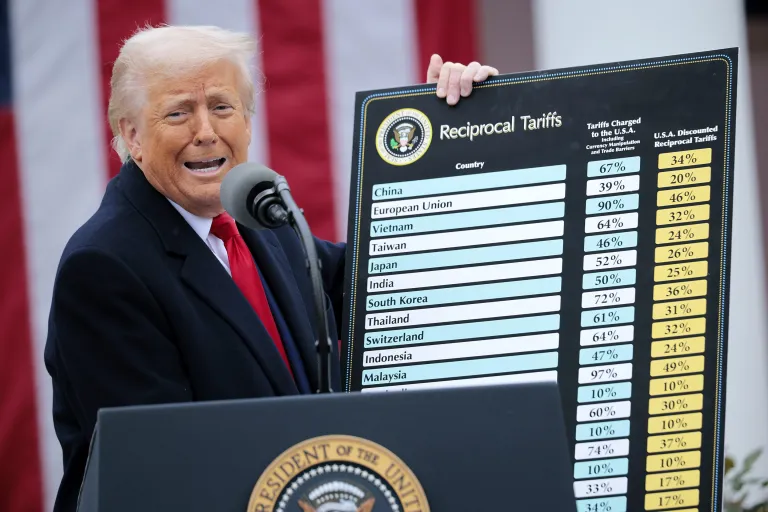
More than a year after President Donald Trump’s “Liberation Day” trade measures, economists are increasingly warning that the Trump tariffs have weakened the U.S. economy while adding pressure to household budgets.
Mark Zandi, chief economist at Moody’s Analytics, said in a note this week that the evidence is now “definitive,” writing that “the tariffs have done significant damage to the economy.” His warning comes as policymakers weigh tariff revenue against slower job growth, higher inflation and new risks from energy markets.
Zandi Says Job Growth Has Stalled Since Tariffs Began
Trump announced the tariff package on April 2, 2025, during a White House event billed as a “Make America Wealthy Again” trade announcement. Since then, economists have had more than a full year of data to assess the policy’s effects.
Zandi said hiring has largely stopped expanding outside healthcare, a sector less exposed to international trade. He also pointed to inflation moving higher, with the personal consumption expenditures deflator rising at a 3% annual pace, compared with 2.5% before the tariff measures and above the Federal Reserve’s 2% target.
That assessment challenges the view of U.S. Treasury Secretary Scott Bessent, who has argued that tariffs did not produce the feared inflation shock. Bank of America economist Aditya Bhave has taken the opposite position, writing that supply shocks can raise inflation because they push aggregate supply costs higher.
Tariff Revenue Has Become a Fiscal Cushion
The policy has also generated substantial revenue for Washington. The Department of Homeland Security collected $287bn in customs duties, taxes and fees in calendar 2025, up 192% from the previous year. About $97.5bn came in the fourth quarter alone.
That money matters because the Trump administration has pursued large fiscal measures, including the One Big Beautiful Bill. Tariff revenue can reduce the need for additional borrowing, although economists remain divided over how dependable that income will be.
The legal picture has also changed. In February, the Supreme Court ruled that Liberation Day tariffs imposed under the International Emergency Economic Powers Act were unconstitutional. The White House then shifted toward other legal authorities, including the 1974 Trade Act, to keep duties in place.
A Second Supply Shock Is Building in Oil
The tariff debate is now colliding with a fresh inflation risk. Oil prices have risen following the U.S. and Israel’s war with Iran, raising concerns that energy costs could further slow growth and push consumer prices higher.
For investors and business leaders, the key issue is whether tariff-driven costs and energy-driven costs begin to reinforce one another. Higher import prices can squeeze retailers, manufacturers and households. Higher oil prices can raise transport, production and utility costs across the economy.
That combination could make the Federal Reserve’s job more difficult. If inflation stays above target while growth weakens, policymakers face fewer easy choices on interest rates.
What Happens Next Depends on Courts and Consumers
The next phase will hinge on three signals: whether consumers continue cutting real spending, whether tariff revenues survive legal challenges, and whether energy markets stabilize.
Former Pimco chief executive Mohamed El-Erian has warned that the global economy can avoid recession if key Middle East shipping routes reopen within four to eight weeks. If that does not happen, he said, the outlook could change materially.
For now, the Trump tariffs have become both a revenue source and an economic risk. The question is no longer whether they matter, but whether the U.S. economy can absorb them alongside a new energy shock.