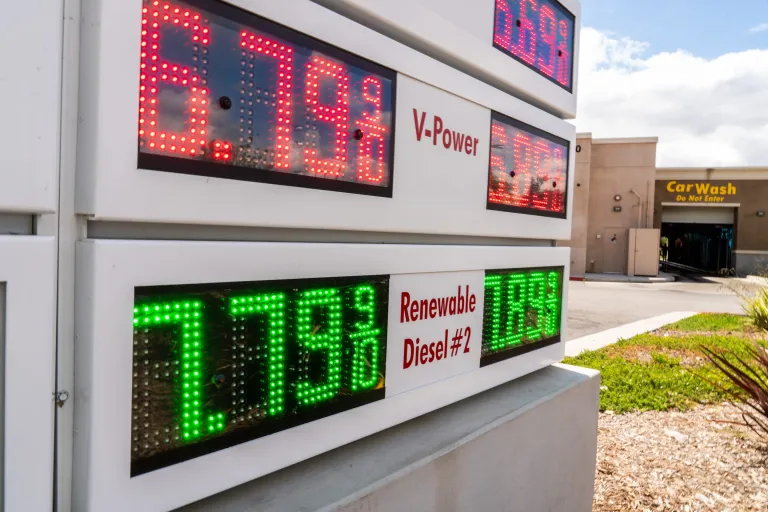
Lower-income Americans are cutting back sharply on fuel use after the Iran war sent gas prices higher, but many are still paying more at the pump, according to new research from the Federal Reserve Bank of New York.
The findings point to a widening divide in how households are absorbing the latest energy shock. While higher-income Americans have largely kept driving, poorer households appear to be changing travel habits to manage costs. The result is a gas prices squeeze that is landing hardest on people with the least room in their budgets.
Poorer Drivers Cut Back, But Still Paid More
The Iran war began on Feb. 28. By the end of March, gasoline prices had increased by about 25%, based on government consumer price data cited in the report. By Tuesday, prices had risen 50% since the start of the conflict.
The New York Fed found that overall gasoline consumption fell 3% in March. The pullback was not evenly distributed.
Households earning less than $40,000 a year reduced gas consumption by 7%, yet their spending on fuel still rose 12% during the month. Households earning at least $125,000 a year cut consumption by just 1%, while increasing gasoline spending by 19%. Middle-income households were between the two groups, although the report did not give specific figures.
The pattern suggests lower-income drivers may be combining errands, carpooling, using public transport, or avoiding discretionary trips. Higher-income households, by contrast, appear to have absorbed the price increase with limited changes to daily behavior.
A Fresh Test for the K-Shaped Economy
The New York Fed researchers said the March data showed a K-shaped pattern in gasoline consumption, with higher-income households maintaining stronger fuel demand while lower-income households pulled back.
That split matters because gasoline is a highly visible expense. Even when headline indicators such as employment and GDP remain steady, higher pump prices can shape how households judge the economy. For workers with fixed commutes, fuel inflation behaves less like a discretionary cost and more like a mandatory charge on income.
The current shock also appears more unequal than the 2022 energy surge after Russia’s invasion of Ukraine. The New York Fed found that wealthier households reduced consumption more in 2022 than they did this time, while lower-income households likely had more support then from pandemic-era government stimulus.
Since 2022, asset-owning households have also benefited from gains in equities and real estate. That wealth buffer can make fuel inflation manageable for higher earners, while lower-income households face the same price board at the station with fewer financial cushions.
Gas Spending Is Crowding Out Other Purchases
The New York Fed estimated that total spending at gas stations rose 15% in March from the previous month. If that continues, more money directed toward fuel could reduce spending elsewhere, especially among households already under pressure from rent, groceries, and utilities.
So far, the broader consumer data show only modest signs of a slowdown. Inflation-adjusted consumer spending rose 0.2% in March, slightly below the 0.3% increase recorded in February.
A separate Bank of America Institute report added another warning sign. Among the lowest-income third of households, one in 10 now spends 10% of income on gasoline. Higher-income households spend an average of 2.7% of income on fuel.
Bank of America Institute data also indicated that discretionary spending growth weakened in March for poorer households, while it improved for middle- and upper-income groups. That suggests the gas shock is not just changing driving behavior, it is also affecting restaurants, retail, entertainment, and other nonessential spending categories.
What to Watch at the Pump
The next key signal is whether gasoline prices remain elevated into the summer driving season. If prices stay high, lower-income households may face a longer squeeze that feeds into weaker discretionary demand.
For investors and business leaders, the risk is not simply higher energy costs. It is the uneven way those costs move through the economy. A fuel shock that wealthier households can absorb may still weaken demand in the parts of the consumer market most exposed to lower-income spending.