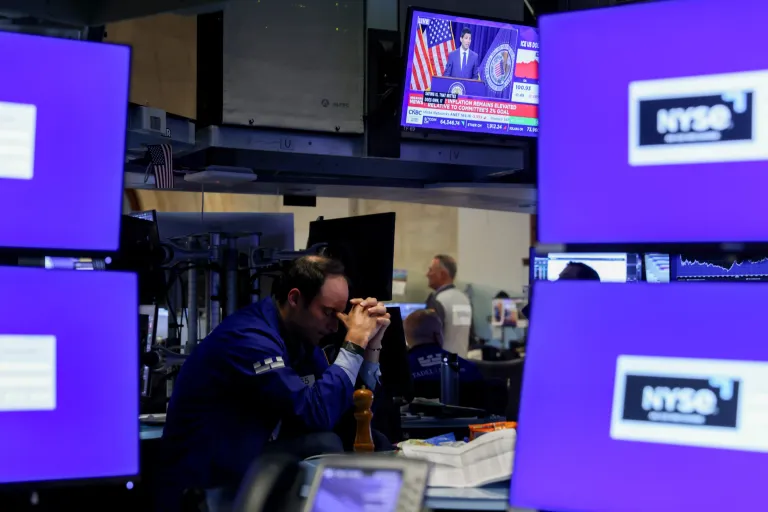
Wall Street delivered a sharp response after Federal Reserve Chair Kevin Warsh chose to leave interest rates unchanged, underscoring investor concerns that inflation may remain stubborn for longer than policymakers expect. Although the Federal Open Market Committee kept borrowing costs steady, financial markets effectively tightened conditions on their own, driving long-term Treasury yields sharply higher while sending US equities to one of their weakest sessions in more than a year.
The market reaction highlighted growing scepticism over whether the Federal Reserve can restore price stability without additional rate increases. Kevin Warsh has repeatedly argued that allowing markets to interpret economic data without extensive forward guidance provides policymakers with a clearer signal of financial conditions, but investors appeared unconvinced that patience alone will be enough.
Treasury markets tighten financial conditions
Following the Federal Reserve’s latest policy announcement, the yield on the 30-year US Treasury climbed 10 basis points to 5.21%, its highest level in nearly two decades. The benchmark 10-year Treasury yield rose to 4.67%, while the two-year yield declined, reflecting expectations that any immediate rate increase may have been delayed rather than abandoned.
Equity investors reacted just as negatively. The Dow Jones Industrial Average closed more than 1,100 points lower, marking its biggest one-day decline since April 2025. The S&P 500 and Nasdaq Composite also ended the session significantly lower as traders reassessed the outlook for inflation and monetary policy.
During his press conference, Warsh suggested that tighter market conditions were already helping the Federal Reserve’s inflation fight.
“We’ve seen a material tightening, not just in nominal rates, but in real rates too, and we’re observing it,” he said.
He also defended his decision to reduce the Federal Reserve’s reliance on forward guidance, explaining that policymakers benefit from receiving what he described as “an unfiltered message from markets” before determining the appropriate policy response.
When asked directly why the committee had not acted despite inflation remaining above its 2% target for more than five years, Warsh rejected suggestions that policymakers were simply delaying action. He said committee members had engaged in extensive debate and stressed that future decisions would depend on incoming economic data rather than current market expectations.
Morgan Stanley Wealth Management chief economic strategist Ellen Zentner said in a client note that investors should not assume additional tightening has been ruled out. Instead, she argued that expectations may simply have shifted toward the Federal Reserve’s September meeting, with inflation reports over the coming weeks likely to determine the outcome.
Productivity assumptions remain under scrutiny
Another element of Warsh’s argument centres on productivity growth. Federal Reserve officials maintained that business investment and productivity remain supportive of economic expansion, potentially allowing inflation to moderate without significantly weakening employment.
That assessment has attracted criticism from some economists. Employ America executive director Skanda Amarnath questioned the Federal Reserve’s characterisation of productivity, arguing that official data do not fully support such confidence and warning against overstating economic strength.
Warsh has previously argued that artificial intelligence investment could eventually lift productivity sufficiently to ease inflationary pressures. However, recent research has produced mixed conclusions. Barclays economists have reported little statistical evidence linking AI adoption to broad productivity gains across industries, while a recent Federal Reserve Board discussion paper found that measurable improvements at the company level have yet to translate into stronger economy-wide productivity.
This debate has become increasingly important because productivity growth determines how quickly the economy can expand without generating additional inflation. If productivity accelerates, businesses can produce more without pushing up prices. If those gains fail to materialise, the Federal Reserve may ultimately face greater pressure to tighten monetary policy.
Investors now focus on incoming inflation data
The market’s response suggests investors are placing greater weight on economic data than policy messaging alone. Treasury yields, equity performance and inflation expectations will continue to influence financial conditions even before the Federal Reserve makes another formal policy decision.
Attention will now shift toward upcoming inflation releases, labour market data and evidence on business investment ahead of the September meeting. Should inflation remain elevated while productivity growth disappoints, policymakers may have fewer opportunities to delay further action.
For businesses, homeowners and investors alike, the coming weeks could determine whether Warsh’s strategy of allowing markets to perform part of the tightening proves effective, or whether the Federal Reserve will ultimately need to reinforce that message with another interest rate increase.