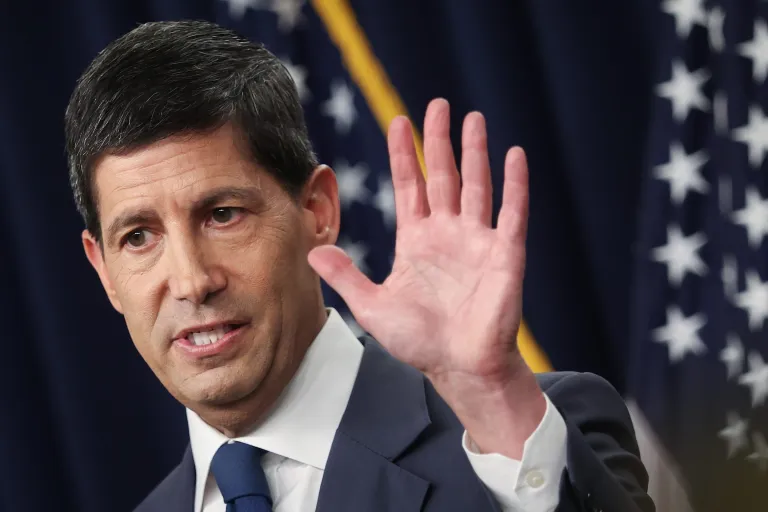
The Federal Reserve’s plan to scale back guidance on future interest rate decisions is drawing criticism from economists and investors, who argue that less communication could create greater uncertainty across financial markets. Federal Reserve Chair Kevin Warsh has defended a move away from detailed policy signalling, saying markets should respond more naturally to incoming economic data instead of relying on central bank forecasts.
The debate over Federal Reserve communication intensified after Warsh’s latest press conference, where he reiterated his long-held opposition to extensive forward guidance. While he believes a less prescriptive approach will provide policymakers with clearer market signals, several leading economists warn that reducing official communication may leave investors relying on speculation rather than facts.
Bond markets reacted quickly after Warsh’s remarks
Warsh, who previously served as a Federal Reserve governor between 2006 and 2011 before returning as chair, has consistently argued that the central bank has become overly dependent on signalling future policy moves. Following last week’s Federal Open Market Committee meeting, he said financial markets should be free to react to economic developments “in the direction and magnitude they see fit,” adding that the central bank does not need to remain at the centre of every market conversation.
Markets responded almost immediately. Long-term Treasury yields climbed following the press conference, while two-year Treasury yields declined as investors reassessed expectations for future interest rate policy.
Analysts said the market reaction reflected growing uncertainty rather than a direct interpretation of any specific policy announcement. Alex Wolf of J.P. Morgan noted that investors were responding to the absence of clear guidance rather than any explicit change in the Federal Reserve’s outlook.
Goldman Sachs chief US economist Jan Hatzius cautioned that reducing official communication could ultimately make financial markets less efficient. In a research note, he argued that investors price assets based on what they believe the Federal Reserve will do. Providing fewer insights into policymakers’ thinking could therefore encourage inaccurate assumptions instead of delivering cleaner market signals.
Hatzius warned that markets might either fail to respond to economic data the Fed later considers important or overreact to isolated data releases and public comments from individual policymakers. Both outcomes, he argued, could increase unnecessary volatility in financial conditions and weaken the effectiveness of monetary policy.
Questions emerge over the Fed’s policy framework
Additional uncertainty arose when Warsh addressed the Federal Reserve’s inflation target. He reaffirmed that the Personal Consumption Expenditures Price Index remains the central bank’s preferred measure for achieving its two percent inflation objective. However, he also suggested that the Federal Reserve’s broader strategy could evolve after January, when ongoing policy reviews are expected to conclude.
That possibility has prompted concerns that investors may struggle to understand the framework guiding future policy decisions before any formal changes are announced.
Jeremy Siegel, emeritus professor of finance at the Wharton School of the University of Pennsylvania and senior economist at WisdomTree, said reducing forward guidance is a reasonable objective. However, he argued that policymakers still have a responsibility to explain the economic principles behind their decisions, regardless of how much they choose to signal future interest rate moves.
The issue extends beyond individual press conferences. Federal Reserve credibility has increasingly depended on clear communication since the global financial crisis, when central banks began using forward guidance as an additional policy tool after interest rates approached zero. Over the past decade, investors have become accustomed to detailed projections, policy statements and economic forecasts accompanying virtually every major decision.
According to the Bank for International Settlements, transparent central bank communication has become an increasingly important element of monetary policy because financial markets rapidly incorporate official guidance into asset prices. A shift away from that model therefore represents one of the most significant changes to Federal Reserve communications in years.
Investors will focus on consistency in the months ahead
The broader test for the Federal Reserve will be whether reduced guidance produces better policy outcomes or simply greater uncertainty. Markets will closely watch future inflation reports, employment data and Federal Open Market Committee meetings for evidence of how Warsh intends to balance flexibility with transparency.
For investors, the immediate challenge is interpreting policy without the detailed roadmap that has characterised Federal Reserve communications for much of the past two decades. Whether that approach delivers more efficient markets or greater volatility is likely to become one of the defining monetary policy debates of the coming year.