American workers are receiving a smaller proportion of economic output than at any point in nearly eight decades of official records, adding to evidence that ownership of assets is becoming increasingly important to how households participate in economic growth.
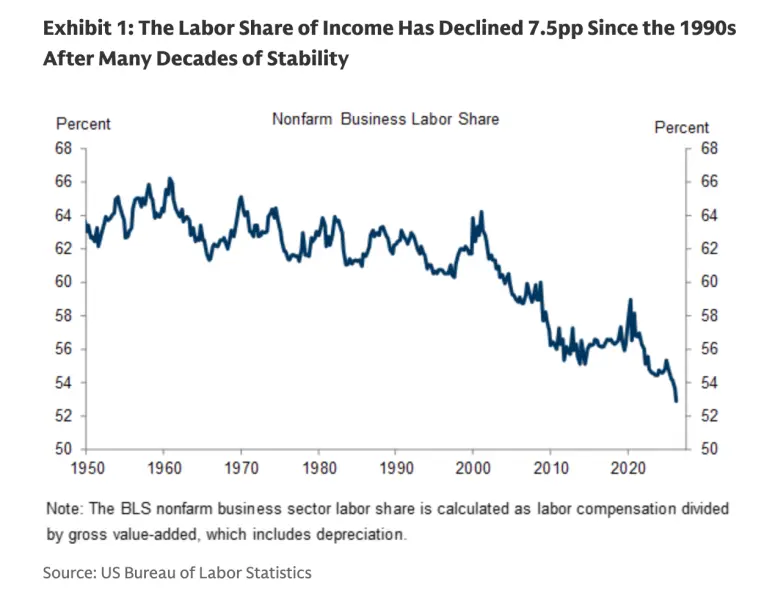
The US labor share in the nonfarm business sector fell to 52.8% in the second quarter of 2026, according to revised Bureau of Labor Statistics data. That is the lowest level in a series dating to 1947. Goldman Sachs estimates that some of the long-term decline reflects accounting effects, but says a substantial portion represents a genuine shift away from labor income.
Goldman Says 40% of the Decline Reflects Measurement
The labor share has fallen by roughly 7.5 percentage points since the 1990s, according to BLS data cited in research from Goldman Sachs economist Abhay Duggirala.
Goldman estimates that approximately 40% of that decline can be explained by changes in how different forms of income and capital are recorded.
One factor is the growth of pass-through businesses. Changes to the US tax system encouraged some business owners to move from traditional corporate structures into entities such as S-corporations and partnerships. As a result, income that might previously have appeared as wages can instead be classified as business income.
Depreciation creates another complication. The labor-share calculation uses gross value added, which includes depreciation. As software, computers and other assets with relatively short economic lives have become more important, depreciation has increased and can reduce the measured labor share without producing an equivalent increase in income available to capital owners.
Equity compensation adds a third issue. Stock-based remuneration is generally recorded as labor compensation when shares vest or options are exercised, rather than when awards are initially granted. That can create a timing gap between economic compensation and the official measure.
Even after adjusting for those factors, Goldman estimates that about 4.5 percentage points of the decline since the 1990s represents a real structural change.
Corporate Profits and Automation Change Who Captures Growth
Goldman identifies higher corporate markups, automation and weaker worker bargaining power as important contributors to the remaining decline. Larger companies with strong market positions can retain more income as profits, while technology can allow businesses to expand output without increasing labor input at the same rate.
That distinction matters because capital ownership is distributed differently from employment income. Workers broadly participate in the economy through wages, while the financial gains associated with rising corporate valuations accrue most directly to households that own shares, funds and businesses.
The Federal Reserve’s financial accounts illustrate the scale of household exposure to financial assets. Its latest accounts put household-sector corporate equity holdings above $52 trillion and mutual fund holdings above $14 trillion, although those assets are not distributed evenly among households.
This creates an important implication beyond the headline labor figure. Two households with similar salaries can experience economic growth very differently if one also owns a substantial portfolio of equities, retirement assets or business interests.
The BLS data provide another useful comparison. Productivity increased at a 1.4% annual rate during the second quarter, while real hourly compensation declined 3.3% during the same period. Over the four quarters through the second quarter, real hourly compensation slipped 0.1%. That does not establish a permanent divergence between productivity and pay, but it shows why the distribution of productivity gains is attracting attention.
AI Could Put Further Pressure on Labor’s Share
Artificial intelligence now adds another variable to the long-running shift. Goldman argues that further automation of workplace tasks could push the labor share lower if companies can produce more with proportionately less human labor.
The outcome will depend partly on where the financial benefits of higher productivity ultimately flow. If AI raises employee productivity and compensation alongside corporate earnings, workers could capture part of those gains. If the benefits appear primarily through margins, profits and asset values, households with substantial capital ownership would be better positioned to benefit.
That makes the labor-share data more than an abstract economic measure. The BLS says the series remained largely between 60% and 66% for much of the postwar period before beginning a sustained decline after the start of this century.
The next question is therefore not simply whether AI lifts US productivity. Investors, employers and policymakers will also be watching how the resulting income is divided between the people doing the work and the people who own the capital behind it.