A year that appeared comparatively calm by wildfire standards delivered the most expensive fire-related losses on record, underlining how the economic impact of disasters is increasingly shaped by where they occur rather than how much land they consume.
Research published in Nature Reviews Earth & Environment found that wildfires accounted for 38% of all insured losses linked to natural hazards in 2025. The finding stands in contrast to the overall scale of global burning, which remained below long-term averages. Around 335 million hectares burned worldwide during the year, roughly 16% below the historical norm of approximately 400 million hectares.
The figures suggest that wildfire losses are becoming more closely tied to population density, infrastructure exposure, and property values than to total acreage burned.
Los Angeles Fires Drove Historic Insurance Losses
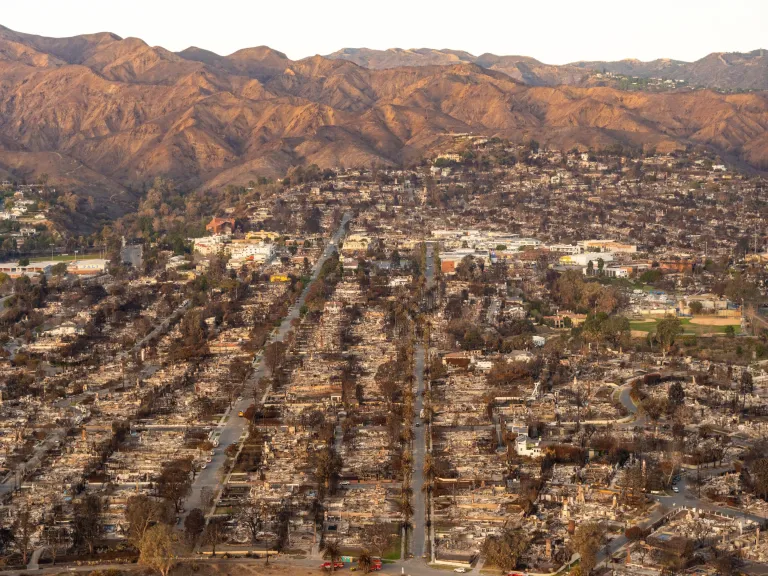
Several major wildfire events defined the year, none more significant financially than the fires that swept through parts of Los Angeles in January 2025.
The Palisades and Eaton fires forced about 200,000 people to evacuate, destroyed more than 18,000 structures, and were associated with up to 440 direct and indirect deaths when smoke-related health impacts are included. According to the study, the disaster generated approximately $140 billion in total losses, including $40 billion covered by insurance.
Researchers noted that the Los Angeles fires ranked among the most expensive natural disasters ever recorded from an insurance perspective. The event highlighted the growing vulnerability of high-value urban regions located near fire-prone landscapes.
Elsewhere, South Korea experienced its largest recorded wildfire outbreak, with roughly 250,000 acres burned. Across Europe, fires scorched about 2.5 million acres and triggered large-scale evacuations. Canada endured its second-worst wildfire season on record, with around 6,000 fires consuming approximately 22 million acres.
Although the number of acres burned globally remained relatively modest compared with recent years, wildfires still caused 90 deaths and displaced roughly 300,000 people through evacuations.
Why Smaller Burn Areas No Longer Mean Lower Risk
The study’s lead author, University of East Anglia physical geographer Matthew Jones, said the events of 2025 demonstrate a widening gap between global fire statistics and real-world consequences.
“2025 shows that a ‘quiet’ fire year globally can still be devastating. We are seeing a growing disconnect between total area burned and real-world impacts, with risk increasingly determined by fire location, intensity, and exposure,” Jones said.
The trend reflects broader changes in wildfire behavior. Scientists have increasingly linked longer heatwaves, extended droughts, and rising temperatures to more severe fire conditions in many regions. Fires are also appearing more frequently in higher-latitude areas that historically experienced less extreme wildfire activity.
Research published in the Proceedings of the National Academy of Sciences previously found that climate change contributed to a doubling of large wildfires and burned area across the western United States over the past four decades.
For insurers and property owners, the challenge extends beyond climate conditions. According to a United Nations disaster risk report released in 2024, global wildfires generated approximately $106 billion in economic losses between 2014 and 2023, including $74 billion in insured losses. During the preceding decade, insured wildfire losses remained below $10 billion.
That acceleration suggests wildfire exposure is becoming a growing balance-sheet issue for insurers, governments, infrastructure operators, and businesses with assets in high-risk regions.
Investors and Insurers Face a New Reality
The concentration of losses in developed markets is becoming increasingly apparent. Before the California fires were included in the data, the United States accounted for nine of the ten most expensive wildfire disasters recorded since 1970, according to the UN report.
At the same time, lower-income countries often face a different challenge. While total financial losses may be smaller, uninsured damage can represent a much larger share of household wealth and local economic activity.
The key lesson from 2025 is that wildfire risk can no longer be measured primarily by hectares burned. As more people and valuable assets move into vulnerable areas, future fire seasons may generate record financial losses even when global fire activity appears relatively subdued.