The U.S. economy expanded at an annualised 1.5% rate in the second quarter, slowing from 2.1% in the first three months of the year as a sharp rise in imports weighed on the headline figure. Beneath that slowdown, however, households and businesses continued to spend at a much stronger pace.
The Commerce Department left its second estimate of U.S. GDP growth unchanged from its initial reading. Consumer spending accelerated significantly between April and June, while business investment remained robust, offering a stronger picture of domestic demand than the overall growth rate alone suggests.
Consumer Spending Accelerates to a 3.4% Pace
Household consumption, which represents roughly 70% of U.S. economic activity, grew at a 3.4% annual rate during the quarter. That marked a substantial acceleration from the 0.5% pace recorded between January and March.
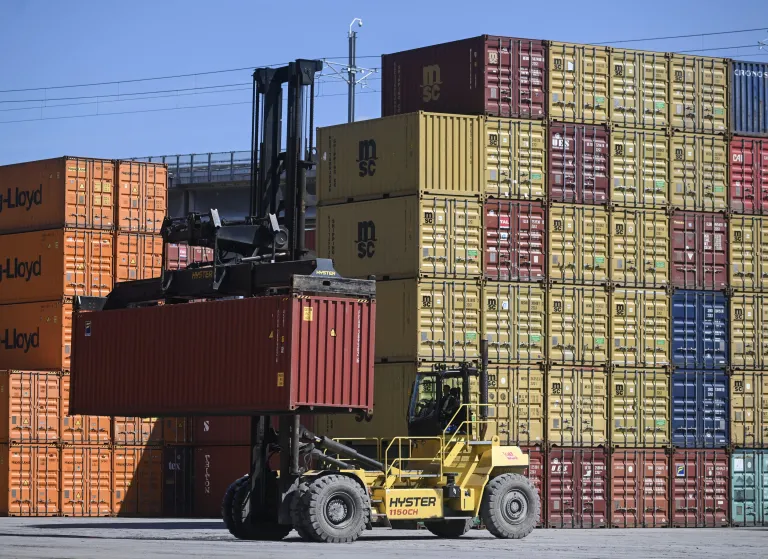
Imports were the principal drag on the GDP calculation. They climbed at a 12.5% annual rate during the second quarter and reduced overall growth by 1.64 percentage points. Because GDP measures production within the United States, imported goods are deducted when calculating the final figure.
Part of that increase reflected shipments of computer chips and other equipment associated with investment in artificial intelligence. The result highlights an unusual feature of the quarter: spending connected with the AI investment cycle supported business activity while simultaneously contributing to higher imports that lowered measured GDP.
Business investment outside the housing sector increased at an 8.5% annual rate, reflecting continued spending on AI-related infrastructure. A separate measure designed to capture underlying private-sector demand by removing volatile trade and government components advanced 4.2%, compared with 1.7% during the first quarter.
Housing investment also increased for the first time since the end of 2024. The improvement came despite a residential property market that has remained under pressure from elevated mortgage rates.
Imports Mask Stronger Domestic Demand
The composition of the GDP report matters because the 1.5% headline figure does not point uniformly to weakening activity. Stronger consumption, business investment and underlying private demand suggest that domestic spending retained momentum even as trade arithmetic pulled down the final growth number.
That distinction could become increasingly important for investors assessing whether the economy is moving toward a broader slowdown. A weak GDP reading caused by falling household or corporate demand would carry different implications from one driven heavily by an import surge. In the second quarter, the Commerce Department figures point more toward the latter.
The economy has also continued expanding despite higher energy costs following the U.S. and Israeli attacks on Iran in late February and the subsequent conflict. Those pressures have complicated the inflation picture just as strong household and corporate spending indicate that demand remains resilient.
The combination creates a difficult backdrop for monetary policy. Economic activity remains firm in several important areas, but inflation is still running well above the Federal Reserve’s 2% objective. That reduces the simplicity of any policy response to slower headline GDP because stronger underlying demand can continue to support price pressures.
Inflation Keeps the Federal Reserve’s Challenge in Focus
A separate Commerce Department report released Wednesday showed that a Federal Reserve-watched inflation measure rose 3.7% in July from a year earlier, matching its annual pace in June. The measure had stood at 2.9% in late February.
Persistent inflation is also becoming more politically significant with the U.S. midterm elections about 10 weeks away. High gasoline prices, possible new tariffs on Canada and China, and rising costs for products including computers, gaming consoles and semiconductors are adding to pressure on household budgets.
The next major revision to the second-quarter growth figures is scheduled for Sept. 30, when the Commerce Department publishes its third and final GDP estimate for the period.
For markets, the details of that report may matter as much as any revision to the headline number. Investors will be watching whether consumer spending and business investment retain their strength, while inflation data will remain central to expectations for Federal Reserve policy. If domestic demand stays firm while price growth remains elevated, policymakers could face an economy that is growing slowly on paper without displaying the weakness normally associated with a conventional slowdown.