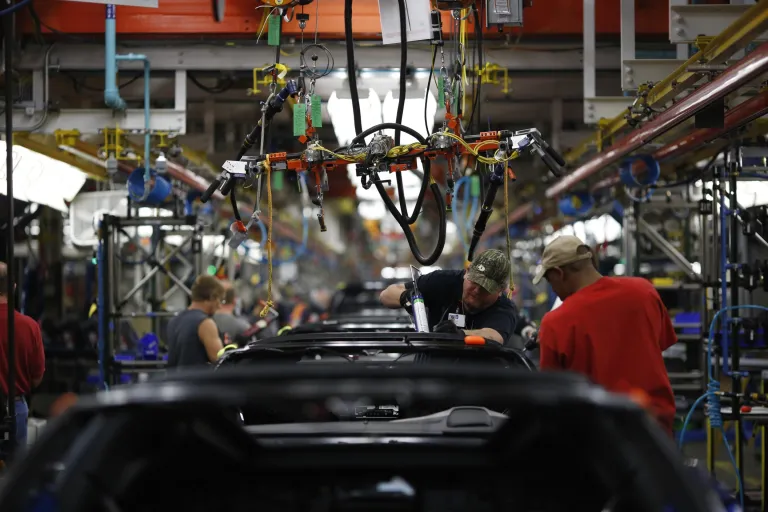
The U.S. auto industry is confronting mounting pressure from overseas rivals as policymakers and industry analysts warn that decades of declining market dominance could weaken America’s broader industrial strength. A new report from the Information Technology & Innovation Foundation, released Monday, argues that the country’s automotive sector has moved from a position of global leadership to one increasingly dependent on imports and foreign competitors.
The report highlights a widening gap between the United States and China in electric vehicles, battery production, and automotive manufacturing capacity. Analysts behind the study said the decline of the U.S. auto industry now carries consequences beyond Detroit, affecting national manufacturing capability and even long-term defense readiness.
America’s Share of Global Car Production Keeps Shrinking
According to the ITIF report, the United States accounted for 46% of global vehicle production in 1965. Today, that figure has fallen to 14.7%. The dominance once held by Ford, General Motors, and Stellantis has also faded sharply in the domestic market, with the combined share of the so-called Big Three dropping from 92% of U.S. auto sales in 1965 to 38% today.
Foreign automakers have steadily expanded their footprint in the American market over recent decades. Data cited in the report from trade group Autos Drive America showed international manufacturers produced 4.9 million vehicles in the U.S. in 2024, slightly ahead of the 4.6 million assembled by the Big Three.
At the same time, imported vehicles continue to claim a larger share of U.S. consumer demand. The report estimated that the cumulative U.S. automobile trade deficit reached $3.3 trillion between 1963 and 2023.
China’s rapid rise in electric vehicles has become a central concern for U.S. lawmakers and manufacturers alike. Chinese automaker BYD overtook Tesla last year as the world’s largest electric vehicle seller, despite having little access to the American market. The ITIF report said China invested heavily in battery research and EV subsidies, with state support for electric vehicles reaching $120.9 billion between 2021 and 2023.
Stephen Ezell, vice president for global innovation policy at ITIF and one of the report’s authors, warned that the United States must treat automotive manufacturing as a strategic priority tied directly to economic and national power.
Detroit’s Challenges Extend Beyond Car Sales
The concerns raised in the report reflect a broader shift in industrial competition that has accelerated since the pandemic. According to McKinsey & Company, electric vehicles are expected to account for more than half of global new car sales by 2035, a transition that is forcing legacy manufacturers to rethink supply chains, software capabilities, and battery sourcing.
American automakers have struggled to balance those investments with profitability. Several major U.S. manufacturers have recently scaled back EV spending plans as higher borrowing costs and softer-than-expected consumer demand complicated the transition away from internal combustion engines.
The report argues that retreating from EV development could leave the United States increasingly isolated while Chinese firms expand internationally. Chinese automakers have already gained traction in Europe, Southeast Asia, and Latin America by offering lower-cost electric models supported by large-scale domestic manufacturing.
The stakes also extend into defense manufacturing. During World War II, General Motors became one of the U.S. military’s largest industrial suppliers, producing tanks, trucks, aircraft engines, and weapons systems. The ITIF report argues that advanced manufacturing skills developed in the automotive sector remain closely linked to national defense production today.
That connection appears to be receiving renewed attention in Washington. Pentagon officials reportedly held discussions last month with Ford and General Motors executives regarding the companies’ capacity to support military production needs as the U.S. seeks to replenish weapons stockpiles.
The EV Race May Shape the Next Industrial Era
The debate now facing policymakers is whether market forces alone can preserve America’s position in global manufacturing. The report calls for increased federal investment in robotics, advanced batteries, and electric vehicle technology, alongside continued restrictions on Chinese vehicle imports.
For legacy automakers, the next several years may determine whether they remain global competitors or become largely domestic manufacturers focused on trucks, hybrids, and gasoline-powered vehicles. Analysts say the outcome could influence not only the future of transportation, but also the country’s standing in advanced industrial production.
As Chinese manufacturers continue expanding overseas, investors and policymakers will be watching whether U.S. automakers can regain momentum in the technologies expected to define the next generation of mobility.