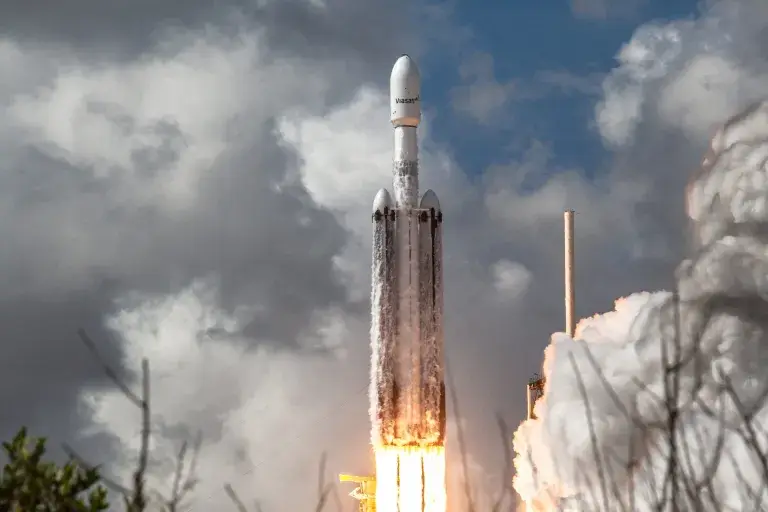
Investors are turning their attention back to the commercial space sector as expectations build around a potential SpaceX stock market debut, a move that could become one of the most closely watched public offerings in recent years.
The renewed focus on the space economy comes as governments and private companies accelerate spending on lunar exploration, satellite infrastructure, and military space programmes. SpaceX remains the dominant player after transforming launch economics with reusable rockets, but a growing list of listed companies now offers investors exposure to different parts of the industry.
The discussion around a SpaceX IPO has also revived interest in companies tied to launch services, satellite manufacturing, geospatial imaging, and orbital communications, sectors that analysts expect to expand sharply over the next decade.
Rocket Makers Compete in a Market SpaceX Reshaped
Founded by Elon Musk in 2002, SpaceX disrupted an industry long controlled by aerospace giants including Boeing and Lockheed Martin. Its Falcon 9 and Falcon Heavy rockets lowered launch costs through reusable booster technology, allowing the company to dramatically increase launch frequency while attracting commercial and government customers.
The company now accounts for more than 80% of global rocket launches, according to the source article, and operates a Starlink network with over 10,000 satellites in orbit. That scale has made SpaceX central to the growing low Earth orbit economy, even as rivals attempt to establish their own positions.
Among the more prominent listed challengers is Rocket Lab, which develops small and medium-lift rockets while also building spacecraft components and offering satellite deployment services. Virgin Galactic continues to pursue the commercial space tourism market for private passengers, researchers, and government missions.
AST SpaceMobile is attempting to build a satellite-based cellular broadband network through its planned BlueBird satellite constellation. Voyager Technologies and Firefly Aerospace are also expanding in the defence and lunar transport segments, with Firefly recently drawing attention after its Blue Ghost robotic spacecraft completed a moon landing mission.
Houston-based Intuitive Machines has also emerged as a notable player in lunar transport. The company develops spacecraft and payload delivery systems for missions to the moon, part of a broader push by NASA and private contractors to establish a long-term lunar presence.
Satellite Data Businesses Gain Strategic Importance
Beyond launch companies, investors are increasingly examining businesses built around satellite imagery and data services.
Planet Labs operates a fleet of imaging satellites that provide geospatial intelligence to governments and corporations. BlackSky Technology similarly offers high-frequency earth imagery and analytics through proprietary satellite infrastructure and external partnerships.
Spire Global focuses on real-time tracking and predictive data, supplying information used in aviation, shipping, weather forecasting, and commodity trading markets.
The growing importance of these services reflects a broader shift in the commercial space sector. According to a 2025 report from McKinsey & Company and the World Economic Forum, the global space economy could approach $1.8 trillion by 2035, driven largely by communications, surveillance, navigation, and data services rather than purely launch activity.
That expansion is also becoming increasingly tied to national security priorities. The United States and China are intensifying competition around lunar exploration and military space capabilities, while President Donald Trump’s proposed “Golden Dome” missile defence initiative has placed additional attention on space-based defence infrastructure.
As a result, traditional defence contractors remain deeply embedded in the sector.
Artemis Missions Keep Legacy Aerospace Groups in the Race
Although newer entrants have captured investor excitement, long-established aerospace groups continue to hold critical positions in government space programmes.
Boeing played a major role in the Apollo missions and later the space shuttle programme. More recently, it contributed to NASA’s Space Launch System used in Artemis lunar missions. Lockheed Martin developed the Orion crew capsule used in the same programme.
The two companies also jointly own United Launch Alliance, the rocket venture that continues to compete for government launch contracts.
Northrop Grumman remains another major force in orbital systems and defence technology. The company helped develop the James Webb Space Telescope and continues to work on satellite systems, spacecraft servicing, and military platforms.
Other defence groups including RTX, General Dynamics, L3Harris Technologies, and Leidos also maintain significant exposure to military and civil space programmes, an area investors increasingly view as a long-term growth market.
What Investors Will Watch Next
A SpaceX listing would likely become a defining moment for the commercial space sector, potentially setting new valuation benchmarks for launch companies and satellite operators.
Investors will now watch whether public market appetite extends beyond Musk’s company to the wider group of space-related businesses that have struggled with volatility since the speculative surge that followed the pandemic-era SPAC boom.
The next phase for the industry may depend less on ambitious visions of tourism or Mars colonisation and more on whether companies can build durable revenue streams from communications, defence contracts, and data services tied to everyday economic activity.