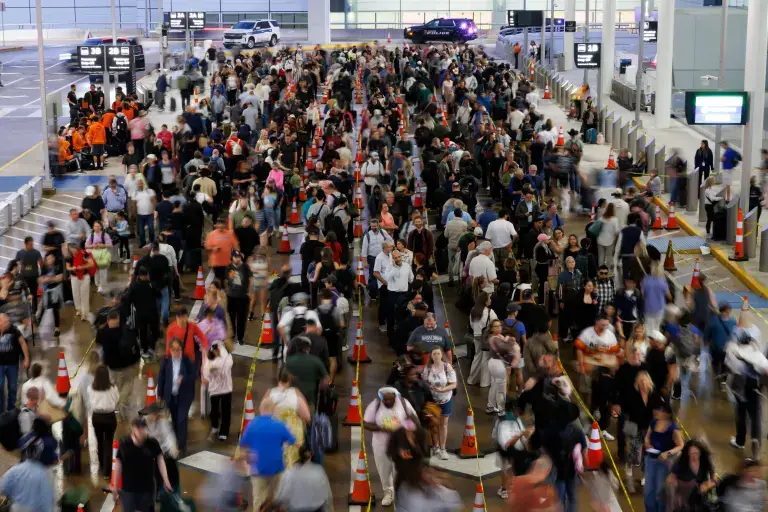
Passengers flying from Boston Logan International Airport will soon be able to clear airport security nearly 25 miles away from the terminal, in a pilot programme that could alter how major US airports manage congestion and passenger flow.
Beginning on June 1, selected Delta Air Lines and JetBlue Airways customers departing Logan will have the option to check in, screen baggage, and pass through Transportation Security Administration procedures at an off-site facility in Framingham, Massachusetts. Travellers will then board a shuttle directly to the airport and enter beyond the traditional security checkpoint.
The initiative forms part of the TSA’s “straight to gate” pilot programme, which has already received approval at eight US airports. Federal officials and private operators are testing whether decentralised screening can ease pressure on overcrowded terminals, particularly at older airports with limited room for expansion.
Framingham facility aims to reduce Logan bottlenecks
The Framingham location, operated by shuttle company Landline, sits roughly 25 miles west of Logan Airport. Under the current trial structure, only passengers travelling on Delta or JetBlue flights departing between 5:30 a.m. and 4 p.m. will be eligible to use the service.
After clearing security and checking luggage at the remote site, travellers will board a shuttle bus costing $9 each way. Parking at the facility will cost $7 per day. The final scheduled shuttle departs at 11 a.m., although actual travel time to the airport could exceed 45 minutes during peak traffic periods.
Passengers arriving at Logan through the programme will bypass the main TSA screening lines entirely and proceed directly into the secure side of the terminal. Checked bags screened at the Framingham site will also travel directly to aircraft handling systems at Logan.
The programme arrives as US airports continue to experience pressure from rising passenger demand. According to Airports Council International, North American passenger traffic surpassed pre-pandemic levels in 2025, driven by sustained leisure travel and a rebound in corporate travel budgets.
US airports are running out of room for expansion
Boston Logan has long faced infrastructure constraints because of its dense urban location and limited ability to expand terminal space or roadway access. Similar issues affect airports in cities including New York, Chicago, and San Francisco, where passenger growth has outpaced physical upgrades.
Industry analysts say off-site security processing could become more common if the Boston trial succeeds. The concept mirrors developments already seen in parts of Europe and the Middle East, where remote baggage handling and early screening systems are used to reduce terminal congestion.
Landline chief executive David Sunde told travel publication The Points Guy that airports increasingly need alternatives because many major facilities lack space for additional security infrastructure. His comments reflect a broader industry concern about how airports will handle long-term passenger growth without extensive redevelopment projects.
The International Air Transport Association estimates global passenger traffic will exceed 5 billion travellers annually within the next few years, putting additional strain on airports already operating near capacity. Building entirely new terminals or runways can take more than a decade and often faces political or environmental opposition, making operational changes more attractive in the short term.
Airlines also have financial incentives to support smoother passenger processing. Long security lines can reduce on-time departures, increase staffing costs, and create customer service challenges during peak travel periods.
What airlines and travellers will watch next
The Boston pilot is likely to serve as a closely watched test case for both regulators and airport operators. If passenger satisfaction remains high and security standards hold, remote screening could gradually expand to additional airports approved under the TSA programme.
Questions remain over whether travellers will embrace the added shuttle transfer, particularly during heavy traffic periods around Boston. Cost, convenience, and reliability will determine whether the model appeals beyond frequent business travellers looking to avoid crowded terminals.
For airlines and airport authorities, however, the trial represents a potentially lower-cost alternative to large-scale terminal expansion projects. As passenger numbers continue climbing, the industry is searching for ways to move travellers more efficiently without rebuilding entire airports.