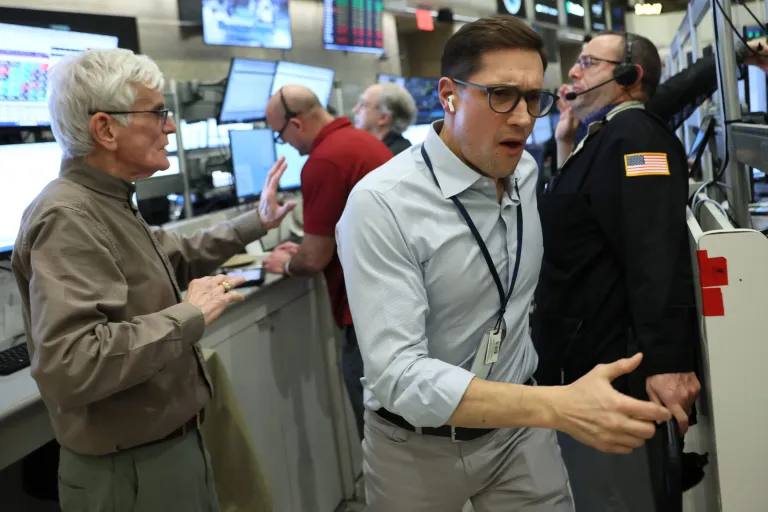
Traders on the floor of the New York Stock Exchange reflect a market wrestling with competing views on artificial intelligence and growth.
A viral essay warning of an impending AI Global Intelligence Crisis has ignited debate across Wall Street, but Citadel Securities has mounted a forceful rebuttal grounded in macroeconomic data and historical precedent.
The speculative memo, published by Citrini Research and widely circulated among investors, imagines a June 2028 scenario in which artificial intelligence devastates the U.S. economy. It projects a 38 percent collapse in the S&P 500, unemployment surging above 10 percent, and a deflationary spiral driven by widespread displacement of white collar workers.
In response, Citadel Securities, the market making firm founded by Ken Griffin, released a detailed macro strategy report disputing the premise. Authored by Frank Flight, the report argues that the AI Global Intelligence Crisis thesis reflects a misunderstanding of labor dynamics, technological adoption curves, and basic macroeconomic accounting.
Viral Forecast or Fictional Macro Memo?
Citrini Research, founded in 2023 by macro analyst James van Geelen, built a following for early calls on artificial intelligence and weight loss pharmaceuticals. Its recent essay, framed as a future macro memo, describes a “human intelligence displacement spiral” in which AI agents replace software engineers, consultants, and managers at scale.
The scenario suggests companies would reinvest labor savings into additional computing power, accelerating layoffs and crushing aggregate demand. It forecasts stress in the 13 trillion dollar residential mortgage market and defaults among private equity backed software firms, including companies such as Zendesk, as clients shift to AI generated in house tools.
Citrini characterizes AI driven output as “Ghost GDP,” arguing that gains accrue to compute owners without circulating through the consumer economy. The essay quickly rose to the top of finance focused Substack rankings, dividing readers between those who saw it as prescient and those who viewed it as alarmist.
Labor Data Tell a Different Story
Citadel’s first line of attack centers on real time labor market data. While the viral memo asserts that software and consulting employment are already contracting, Citadel cites job posting data showing software engineer demand rising by double digits year over year in early 2026.
The firm also references analysis from the Federal Reserve Bank of St. Louis, which tracks generative AI usage through survey data. According to Citadel, daily AI use at work remains stable and does not indicate imminent mass displacement.
Beyond employment, business formation in the United States continues to expand. Construction hiring has also accelerated, fueled in part by large scale data center development tied to AI infrastructure. These trends, Citadel argues, are inconsistent with an economy entering a self reinforcing collapse.
The S Curve Reality Check
At the core of Citadel’s critique is what it describes as a conceptual error. The AI Global Intelligence Crisis thesis assumes that because AI systems can iteratively improve code, economic adoption will compound at the same pace.
Citadel counters that technological diffusion historically follows an S curve. Adoption begins slowly, accelerates as costs decline, then plateaus as markets saturate and marginal returns diminish. Even transformative technologies, from electrification to the internet, faced physical, regulatory, and capital constraints.
Compute capacity and energy supply impose tangible limits. If the marginal cost of computing rises above the cost of human labor for certain tasks, firms will not automate those functions. In Citadel’s view, these constraints create natural economic boundaries that prevent the runaway feedback loop envisioned in the viral essay.
Productivity Shock or Demand Collapse?
Citadel’s most pointed criticism addresses macroeconomic fundamentals. The viral memo suggests AI will simultaneously raise output and destroy aggregate demand, an outcome the firm considers inconsistent with standard economic theory.
Productivity gains are positive supply shocks. They lower marginal costs, expand potential output, and increase real income. Historically, lower prices have boosted purchasing power, stimulating new forms of consumption and investment.
The debate echoes earlier economic discussions. Commentators including Robert Armstrong have urged nuance, while tech analyst Paul Kedrosky has referenced the concept of an Engels pause, associated with historical wage stagnation during early industrialization. Even so, Citadel argues that profits generated by efficiency gains are rarely idle. They are reinvested, distributed, taxed, or spent.
The firm also contends that AI will function more as a complement than a pure substitute for labor. Complex physical, relational, and supervisory tasks remain difficult to automate at scale. As a historical parallel, Citadel asks whether the advent of Microsoft Office eliminated office workers or instead reshaped their roles.
A Familiar Anxiety
Citadel closes its rebuttal with a reference to John Maynard Keynes, who predicted in 1930 that productivity gains would eventually produce a 15 hour workweek. Productivity soared, yet employment persisted as consumer preferences evolved and new industries emerged.
The firm argues that fears embedded in the AI Global Intelligence Crisis echo past anxieties about mechanization and digitalization. While acknowledging that labor markets can experience adjustment periods, Citadel maintains that historical evidence favors adaptation over collapse.
For investors, the clash highlights a broader truth. Artificial intelligence represents a significant technological shift with distributional consequences, but extrapolating worst case scenarios without grounding them in macroeconomic fundamentals may prove more dramatic than durable.