A growing number of American households are struggling to keep up with inflation as wage growth falls behind rising living costs, even while wealthier consumers continue spending freely on travel, entertainment and investments.
New data from the University of Michigan showed U.S. consumer sentiment dropped to 49.8 in April, the weakest reading since the survey began 74 years ago. Economists say the decline reflects mounting pressure on working- and middle-class households as fuel prices rise and borrowing costs remain elevated.
The deterioration comes at a moment when financial markets are reaching fresh highs, exposing an increasingly uneven economy where higher earners continue to benefit from asset gains while lower-income consumers rely more heavily on debt to cover everyday expenses.
Fuel Costs and Inflation Are Hitting Workers Hardest
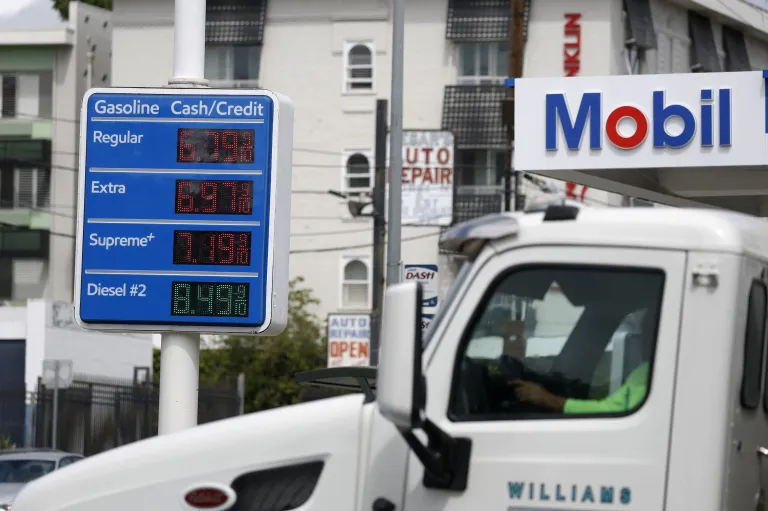
Average hourly earnings increased 3.6% over the past year, according to the latest labor market report from the Bureau of Labor Statistics. Inflation for April is expected to approach 4%, largely driven by rising energy prices linked to tensions in the Middle East.
Joseph Brusuelas, chief economist at RSM, warned that inflation-adjusted wages could turn negative in the coming months as higher transportation and fuel costs move through the economy.
Heather Long, chief economist at Navy Federal Credit Union, said many consumers are already feeling the impact.
“Americans are literally getting squeezed now,” Long said. “It’s not just a vibe, it’s a financial reality.”
Retail spending has remained relatively resilient, with March sales rising 4% from a year earlier. But economists say the gains are increasingly concentrated among higher-income households.
Mark Mathews, chief economist at the National Retail Federation, described current spending patterns as “bifurcated,” with wealthier consumers continuing to spend on discretionary purchases while lower-income households scale back.
Research from the Federal Reserve Bank of New York found that affluent households have largely maintained gasoline consumption despite rising prices, while lower-income Americans have reduced driving and shifted toward public transportation where possible.
Long said Navy Federal’s internal data shows a widening divide between households earning above roughly $125,000 annually and everyone else. Higher earners continue to book vacations and leisure travel, while many lower-income consumers are increasingly turning to personal loans and credit cards.
Wall Street Gains Are Outpacing Household Incomes
The contrast between financial markets and household finances has become more pronounced in recent months. The S&P 500 touched 7,400 for the first time on Friday, supported partly by slowing wage growth that investors believe could reduce inflation pressure.
Mohamed El-Erian, chief economic adviser at Allianz, noted that labor’s share of U.S. economic output has been declining for years and recently reached its lowest level on record in Bureau of Labor Statistics data.
That trend has accelerated since the pandemic recovery, as rising stock prices and higher interest income boosted wealthier households with significant investments. Many wage earners, however, continue to face elevated costs for housing, transportation, insurance and groceries.
Bank of America research released this week showed the widest wage growth gap between high-income and lower-income households since 2015.
The divide mirrors a broader trend seen across developed economies. According to research from McKinsey Global Institute, asset appreciation has significantly outpaced income growth for middle-income workers over the past two decades, contributing to greater financial inequality and weaker consumer confidence.
For businesses, the split creates two very different consumer markets. Luxury travel brands, cruise operators and premium entertainment companies continue to report strong demand, while discount retailers and consumer lenders are seeing signs of growing financial stress among lower-income shoppers.
The Next Risk Is a Pullback in Consumer Spending
Despite weakening confidence, the broader labor market remains relatively stable. The U.S. added 115,000 jobs in April, while unemployment held steady at 4.3%.
Economists caution, however, that consumer sentiment often weakens before broader economic slowdowns appear in hiring data. Rising credit card balances and reduced discretionary spending could become early warning signs that households are beginning to retrench.
The coming months will likely determine whether current financial strain remains manageable or evolves into a more significant slowdown for the U.S. economy. For now, the data suggests that America’s economic recovery continues to benefit wealthy households far more than the workers driving everyday consumption.