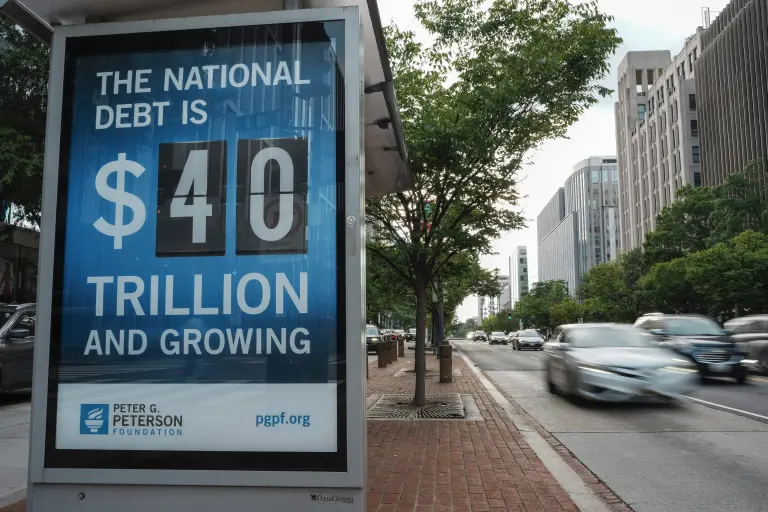
America’s federal debt has moved beyond $40 trillion, with new congressional calculations showing the total increasing at an average pace of more than $5 million every minute over the past year. The Joint Economic Committee puts the U.S. national debt at the equivalent of $117,279 for each person and $297,522 for every household.
Those figures do not represent invoices that Americans will personally receive. They do, however, illustrate the scale of federal borrowing as Washington faces higher financing costs and another trillion-dollar milestone that could arrive within months if the recent pace continues.
Federal Debt Added $2.67 Trillion in One Year
The Joint Economic Committee’s monthly budget update shows gross federal debt increased by $2.67 trillion compared with the same point a year earlier. Over five years, the increase has reached $11.68 trillion.
Measured over shorter periods, the numbers become more striking. The committee calculates that debt grew at an average $85,111.72 per second during the past year. That translates to approximately $5.11 million a minute, $306.4 million an hour and $7.35 billion each day.
On a per-person basis, the debt burden has risen by $7,806 over the past year. The equivalent increase for each U.S. household was just under $20,000.
The trajectory is also putting the next major threshold within sight. If debt continues expanding at its average daily rate of the past three years, the committee estimates that the total will reach $41 trillion around the middle of January 2027. At the same pace, $42 trillion would follow roughly 151 days later, around June.
The calculations arrive shortly after federal debt crossed $40 trillion in August, placing renewed attention on the speed of borrowing rather than simply the headline total.
Higher Rates Are Making the Debt More Expensive
The size of the debt is only part of the fiscal equation. The interest rate Washington pays to finance its obligations determines how heavily existing borrowing weighs on future federal budgets.
According to the Joint Economic Committee, the average interest rate across total marketable national debt stood at 3.475% in August 2026. That compares with 3.415% a year earlier and 1.458% five years ago.
The committee also reported $294.76 billion in interest payments to trust funds during the latest 12-month period, equivalent to an average of $24.56 billion a month.
That comparison with 2021 is particularly important. A government can carry a large stock of debt more easily when financing costs are low. When rates rise, refinancing maturing securities can gradually shift more federal resources toward interest payments, even before additional borrowing is considered.
For businesses and investors, this makes the composition and cost of the debt at least as important as the $40 trillion headline. Persistently high government borrowing can increase competition for capital, while higher Treasury yields can influence financing benchmarks used throughout the economy, from corporate borrowing to mortgages.
There is also an important distinction between gross federal debt and a household liability. Dividing the total by the population helps communicate its scale, but the resulting $117,279 figure is not an amount each American legally owes. Federal debt is serviced through government finances over time, making tax revenue, economic growth, spending decisions and borrowing costs more relevant to its sustainability than a simple per-capita calculation.
Markets Have Yet to Treat $40 Trillion as a Crisis
The rapid increase does not mean a debt-driven market crisis is inevitable. Despite repeated warnings about federal borrowing, the Treasury market has continued functioning, and elevated longer-term yields can reflect several forces beyond concern about government debt.
That distinction matters because the United States issues debt in its own currency and operates the largest sovereign bond market in the world. The more immediate question for investors is whether borrowing costs remain high enough to make interest expense an increasingly restrictive part of the federal budget.
Michael Peterson, chairman and chief executive of the Peter G. Peterson Foundation, has argued that households can still experience the consequences indirectly through interest rates, taxes and broader living costs.
“When the U.S. borrows this much, and continues to borrow more and more, that drives up interest rates, which then increases household expenses because your mortgage goes up, your car loan, your credit card bills, and inflation more generally,” Peterson previously told Fortune.
The $41 Trillion Threshold Is Already in Sight
The next test will be whether the recent borrowing trajectory persists into 2027. On the Joint Economic Committee’s projection, another $1 trillion could be added by mid-January, followed by the next trillion around June.
For markets, the milestones themselves matter less than the underlying direction of deficits, Treasury financing costs and economic growth. If borrowing continues at its recent pace while interest rates remain well above their levels of five years ago, debt servicing will command greater attention in future federal budget decisions.
That makes the cost of carrying America’s debt, rather than the number on the debt clock alone, one of the key fiscal indicators to watch.