A planned walkout by tens of thousands of Samsung Electronics workers could disrupt one of the most critical supply chains in artificial intelligence, raising concerns across the global semiconductor industry as demand for advanced memory chips accelerates.
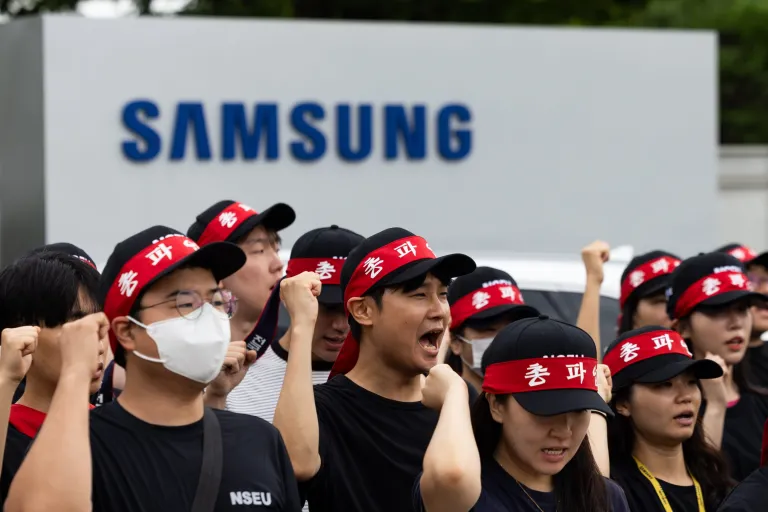
Nearly 45,000 unionised employees are expected to begin an 18-day strike on May 21 after wage negotiations between Samsung and labour representatives failed to reach an agreement. The dispute centres on profit-sharing, bonuses, and salary increases at a time when the company’s semiconductor business has returned to record profitability.
The scale of the planned stoppage has drawn attention well beyond South Korea because Samsung remains one of the world’s dominant producers of DRAM and high-bandwidth memory, known as HBM, both of which are essential for AI servers and Nvidia-powered data centres.
Samsung Faces Pressure Over Bonus Demands
The labour dispute follows mounting pressure from Samsung employees after rival chipmaker SK Hynix agreed to significantly richer compensation packages tied directly to operating profit.
Samsung’s union is seeking a 7% wage increase, the removal of bonus caps, and a long-term profit-sharing structure that would allocate 15% of operating profit to employees. Management reportedly countered with a temporary arrangement closer to 13% for 2026 only, without broader structural commitments.
Negotiations intensified after mediation efforts at South Korea’s National Labor Relations Commission failed earlier this month. Union representatives subsequently requested direct involvement from Samsung co-chief executive Jun Young-hyun before any further discussions continue.
The dispute comes as Samsung attempts to rebuild momentum in the fast-growing AI memory market. Although the company regained leadership in overall DRAM market share late last year, it has struggled to match SK Hynix in HBM, the specialised memory used in advanced AI systems.
Industry analysts estimate Samsung controls roughly one-third of global DRAM production, while Samsung and SK Hynix together account for most of the global HBM market alongside US-based Micron Technology.
Even a temporary slowdown could affect global supply. During a previous one-day labour action in April, local reports suggested foundry production dropped sharply while memory fabrication also slowed. Samsung has reportedly started scaling down some wafer input processes to avoid costly losses if production lines stop mid-cycle.
AI Demand Has Turned Memory Chips Into Strategic Assets
The dispute highlights how memory manufacturers have become increasingly central to the AI investment boom.
While companies such as Nvidia dominate headlines around AI infrastructure, memory suppliers now occupy a similarly important position because advanced GPUs cannot operate without HBM modules attached to them. According to Deloitte, global spending on AI infrastructure is expected to continue rising sharply through the decade as cloud providers expand data centre capacity to support generative AI workloads.
That demand has already tightened supply conditions across the memory market. Earlier this year, reports in South Korea suggested Apple moved quickly to secure memory supplies for future iPhone production amid expectations of steep price increases from Samsung.
Samsung has also been investing heavily to strengthen its semiconductor operations. The company is expected to spend around $73bn this year on semiconductor capital expenditure and research, one of the largest annual investment programmes in the industry.
The labour unrest arrives at a sensitive moment because Samsung has spent the past two years attempting to recover lost ground in HBM after delays in meeting Nvidia’s qualification requirements for some advanced memory products. SK Hynix used that period to expand its lead with AI-focused customers, helping it overtake Samsung in parts of the memory market for the first time in decades.
Analysts say any prolonged production disruption could slow Samsung’s recovery just as AI-related orders accelerate globally.
Investors Will Watch Whether Talks Resume Quickly
Financial markets are now focused on whether Samsung management and union leaders can reach a compromise before the planned strike begins.
JPMorgan analysts have estimated that fully meeting union demands could reduce Samsung’s 2026 operating profit by between 7% and 12% because of higher labour costs alone. Additional production interruptions would increase pressure further if fabrication lines remain idle for an extended period.
The dispute also carries wider implications for South Korea’s economy and equity markets. Samsung and SK Hynix together account for a substantial share of the country’s stock market value and tax revenues, meaning any disruption to semiconductor output quickly becomes a national economic issue.
For global technology companies dependent on AI infrastructure, the next several days may determine whether one of the industry’s most important supply chains faces a significant interruption during a period of already constrained chip supply.