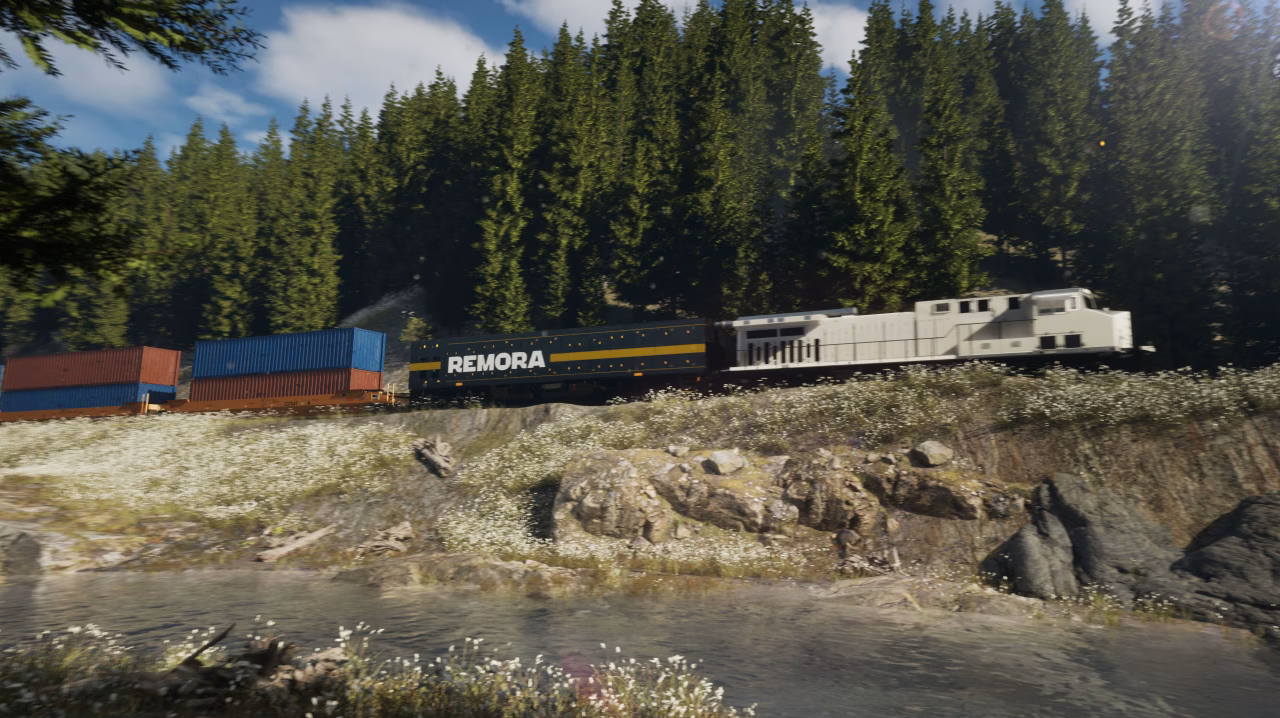
Most startups ship code. Remora just bought a 4,400-horsepower locomotive and parked it in a Detroit suburb.
The five-year-old company is taking an ambitious—and very physical—approach to climate tech. It’s building mobile carbon-capture systems that attach to diesel locomotives and semi trucks, trapping CO₂ emissions at the source, purifying and liquefying the gas on board. Then it sells the captured carbon to buyers in agriculture, food, and industrial sectors.
As seen in Millionaire MNL, it’s one of the boldest moonshots in transportation decarbonization—and it’s finally reaching scale after a long road of trial, error, and $117 million in venture backing.
Turning freight into carbon capture infrastructure
The startup, led by 28-year-old CEO and co-founder Paul Gross, plans to retrofit diesel engines without requiring full electrification. The system attaches to trucks or trains and channels exhaust through a series of high-tech cylinders filled with adsorbent pellets, similar in texture to couscous. These pellets trap CO₂ in microscopic pores.
The gas is then vacuumed out, compressed, and cooled into liquid form, ready for resale.
According to Gross, the current system can capture up to 1 ton of CO₂ per hour, with truck-scale efficiency reaching up to 90%. On freight trains—where weight and space are less of an issue—Remora believes the technology can become even more efficient.
The company’s latest innovation will be mounted on a separate tender car attached to freight locomotives, allowing large-scale carbon capture without redesigning the entire vehicle.
From failure to redesign to real traction
Like many climate hardware startups, Remora had a rough start. In 2023, a pilot test with Ryder System revealed major issues: the system added backpressure to the engine and became waterlogged.
Rather than fold, the team redesigned the system, selected a new adsorbent, and improved flow dynamics. The second-gen version is now in testing, with positive early results. Freight leaders like Union Pacific, Norfolk Southern, and Pacific Harbor Lines have signed technology evaluation agreements, along with trucking giants Ryder and DHL.
“We didn’t expect the problems to be so hard,” Gross said. “But solving them forced us to build something better.”
Railroads see value—even without policy support
Despite a lack of federal policy incentives, demand is growing. “Even though there may not be as many regulations, a lot of our customers still view this as important over the long term,” said Peter Gilbertson, CEO of Anacostia Rail Holdings.
Norfolk Southern’s Chief Sustainability Officer Josh Raglin noted that trains are especially well-suited for carbon capture due to their large diesel volumes and tolerance for added weight. One locomotive can burn up to 5,000 gallons of diesel per refueling—producing an estimated 56 tons of CO₂.
“It easily pencils out for us,” Raglin said, without disclosing financial terms.
As seen in Millionaire MNL, the appeal isn’t just sustainability—it’s economic. Rail companies are looking for ways to decarbonize legacy fleets without waiting for electrification to scale.
Long-cycle hardware, high-stakes investors
Remora has raised $117 million to date, including a $60 million Series B in 2023 led by Valor Equity Partners. The round was committed in tranches tied to milestones, giving investors downside protection and the startup runway to build real hardware.
Other backers include Lowercarbon Capital, Union Square Ventures, Neo Ventures, First Round Capital, Voyager Ventures, and RyderVentures.
“We knew we were backing a long shot,” said Clay Dumas, founding partner at Lowercarbon. “But if it works, the upside is enormous.”
Gross says the company is approaching positive unit economics. With buyers already lined up for liquified CO₂ and demand increasing for clean freight solutions, Remora believes it can generate real returns even in today’s policy landscape.
A path few others are willing to take
Mobile carbon capture has been a white whale in climate innovation circles for decades—expensive, bulky, and difficult to commercialize. But Remora may have cracked it by focusing on retrofit solutions for real-world freight systems and finding early customers who see both cost savings and emissions cuts.
The company expects to begin full-scale train tests next year, using the newly acquired GE locomotive as a proving ground.
“This isn’t software,” Gross said. “It’s hard. But we believe we’re building one of the cheapest, most efficient carbon-capture systems out there—and we’re doing it where the emissions are.”
Source: WSJ