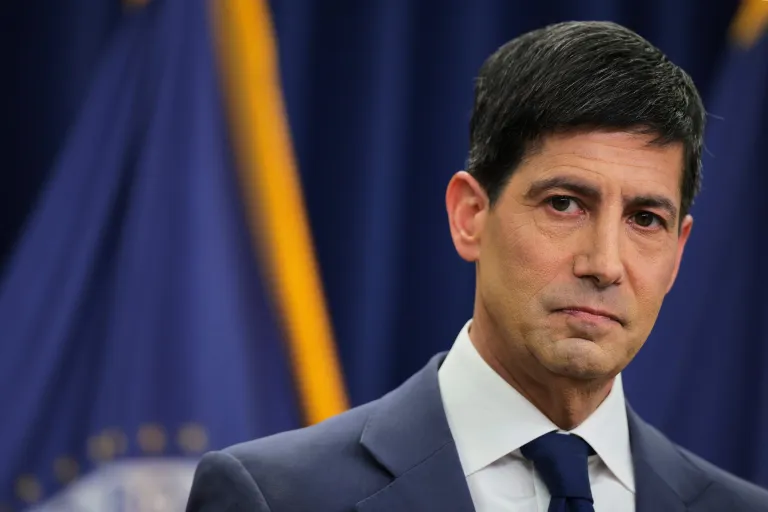
Federal Reserve chair Kevin Warsh used his first policy meeting to send a clear message to investors: bringing inflation back to target will take priority over satisfying market expectations or political pressure.
The US central bank left interest rates unchanged on Wednesday, but markets focused on a more important development. Warsh repeatedly stressed that inflation remains unacceptably high and indicated the Federal Reserve is prepared to maintain a restrictive stance for longer if necessary.
His remarks immediately challenged assumptions that he would quickly pivot towards lower borrowing costs after replacing Jerome Powell earlier this year. Investors responded by selling equities and increasing expectations that another rate increase could still happen in 2026.
For months, economists and investors had debated whether Warsh would govern as an independent central banker or align himself more closely with President Donald Trump’s preference for lower interest rates. Wednesday’s appearance provided an early answer.
Markets Repriced the Path for Interest Rates
The Federal Reserve maintained its benchmark interest rate between 3.0% and 3.75%, a decision that was widely anticipated.
However, policymakers adopted a more cautious tone about inflation. Nine of the Fed’s 18 officials now expect at least one additional rate increase before the end of the year, while language that previously suggested a bias towards easing monetary policy was removed from the statement.
During his press conference, Warsh repeatedly returned to one theme: restoring inflation to the Fed’s 2% target.
“The ‘two’ is the left of the decimal point. For now, ‘zero’ is to the right,” he told reporters.
He described the commitment to price stability as “strong, unanimous, and unambiguous”, adding that the central bank had failed to communicate that message consistently over the past five years.
Financial markets reacted swiftly. The Dow Jones Industrial Average dropped more than 500 points after earlier reaching a record intraday high. The S&P 500 fell 1.2%, while the Nasdaq Composite lost 1.3%.
Short-term Treasury yields also rose sharply, with the two-year note climbing to 4.21%, reflecting higher expectations for future borrowing costs.
Investors who had largely dismissed the possibility of another rate increase this year suddenly reassessed their outlook.
Why Warsh’s Approach Matters Beyond One Meeting
Warsh’s comments represent more than a single policy decision. They may signal a broader effort to restore credibility to a central bank that has faced criticism for allowing inflation to remain above target for several years.
Before becoming Fed chair, Warsh argued that inflation was driven more by excessive government spending than by a strong labour market. He had also suggested that productivity gains from artificial intelligence could support economic growth without reigniting price pressures.
On Wednesday, he adopted a more cautious approach.
When asked whether AI would create room for future rate cuts, he avoided making direct promises and instead pointed to a new internal task force studying the issue.
Warsh also announced five separate review panels that will examine Federal Reserve communications, balance sheet policy, data collection, the impact of AI on employment, and the bank’s inflation framework. Their findings are expected by the end of the year.
The moves suggest Warsh is attempting to build a longer-term policy agenda while giving himself flexibility during a period of economic uncertainty.
His refusal to provide forward guidance also marks a departure from recent Fed practice. Rather than signalling future decisions in advance, Warsh argued that investors should rely on incoming economic data instead.
The Fed Is Entering a New Credibility Test
Warsh inherits a Federal Reserve operating in a very different environment from the one Jerome Powell faced when he began his tenure.
According to data from the US Bureau of Labor Statistics, inflation has remained persistently above the Fed’s target since the pandemic-era surge, forcing central bankers around the world to prioritise price stability over supporting growth.
This challenge extends beyond the United States. The European Central Bank and the Bank of England have also struggled to balance economic expansion with controlling inflation.
For investors, Warsh’s stance introduces a new variable. Markets have become accustomed over the past decade to central banks stepping in to support asset prices during periods of weakness. His comments suggest that protecting market sentiment may no longer be a priority.
That shift could produce greater volatility but may also restore confidence in the Fed’s inflation-fighting credentials over time.
What Investors Should Watch Next
Attention will now turn to July’s Federal Reserve meeting and upcoming inflation data releases.
If price pressures remain stubborn, markets may have to adjust to a longer period of elevated interest rates.
Warsh has built much of his public economic philosophy around one principle: inflation is a policy choice that central bankers can control if they act decisively enough.
His first meeting as chair suggests he intends to govern accordingly.
The immediate market reaction may have been negative, but investors are now confronting a reality they had not fully priced in, a Federal Reserve chair willing to put inflation control ahead of short-term market comfort.