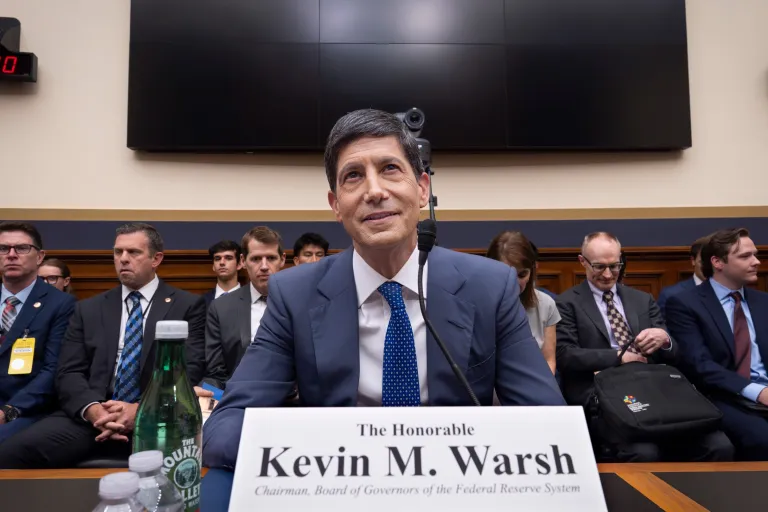
Federal Reserve Chair Kevin Warsh used his first congressional testimony since taking office to deliver a firm message on inflation while offering little indication of where interest rates may be headed next.
Appearing before the House Financial Services Committee on Tuesday, Warsh said policymakers remain committed to bringing inflation fully under control, even as the latest economic data pointed to a broader slowdown in price growth. His remarks left investors without a clear signal on whether the central bank has finished tightening monetary policy or could still raise borrowing costs later this year.
The uncertainty comes at a sensitive moment for financial markets. Inflation has eased substantially from recent highs, yet it remains above the Federal Reserve’s long-standing 2% target, while geopolitical tensions and political scrutiny continue to complicate the outlook for monetary policy.
June Inflation Data Gives Policymakers New Questions
Warsh’s testimony followed the release of fresh government figures showing inflation cooled in June. Consumer prices rose 0.4% from May, helped largely by lower gasoline costs. Core inflation, which strips out food and energy prices, was unchanged during the month and came in below many economists’ expectations.
On an annual basis, headline inflation slowed to 3.5% from 4.2% in May. Core inflation eased to 2.6% year over year, down from 2.9% a month earlier. While the trend suggests price pressures are moderating, the data still shows inflation running above the central bank’s objective.
Warsh cautioned against drawing sweeping conclusions from a single report.
“There might be some that look at this morning’s data and say, ‘mission accomplished,'” he told lawmakers. “That is not my view.”
His comments reflect the challenge facing a divided Federal Open Market Committee. Projections released last month showed policymakers split on the outlook, with some expecting additional rate increases while others favored holding rates steady or eventually reducing them.
The renewed conflict involving Iran has also added another variable. Oil prices have moved higher in recent weeks, raising concerns that energy costs could once again feed into broader inflation measures if the trend persists.
Fed Independence Faces Fresh Political Scrutiny
Warsh also faced questions about how he would respond if President Donald Trump publicly pressured the Federal Reserve to alter policy decisions.
Trump frequently criticized former Fed Chair Jerome Powell and has continued to comment on interest rate policy. Asked whether he was prepared to resist political pressure, Warsh emphasized that decisions would remain grounded in economic evidence.
“My commitment to you is to follow the law and follow the data, follow our very best judgment,” he said.
The Fed chair also pointed to a recent Supreme Court decision allowing Governor Lisa Cook to remain on the central bank’s board after an effort to remove her, describing the ruling as reinforcing the institution’s independence.
The issue has become increasingly important for investors because central bank credibility often influences inflation expectations. Economists generally view an independent Federal Reserve as essential for maintaining confidence in long-term price stability.
AI Investment Emerges as a New Inflation Variable
One area receiving increased attention from policymakers is the surge in artificial intelligence spending across the technology sector.
Warsh described AI-related investment as “the most striking feature of the economy right now” and said the Federal Reserve is closely monitoring its impact on prices and employment. Major technology companies including Alphabet, Microsoft, Amazon and Meta have committed substantial capital to AI infrastructure, driving demand for advanced semiconductors and computing hardware.
According to McKinsey estimates, global spending on AI infrastructure and related technologies could reach trillions of dollars over the coming decade. That investment wave is already influencing supply chains, particularly in semiconductors, where strong demand has contributed to higher component prices.
For policymakers, the question is whether productivity gains from AI ultimately offset inflationary pressures created by increased investment and hardware demand. The answer could influence how the Federal Reserve interprets future economic data.
Other Fed officials have offered differing views on the path ahead. Governor Christopher Waller recently suggested stronger inflation readings could justify further tightening, while New York Fed President John Williams indicated steady rates may be sufficient if inflation continues to moderate.
What Markets Will Watch Next
Warsh’s testimony reinforced a central theme likely to shape the remainder of 2026: the Federal Reserve is not ready to declare victory over inflation.
Investors will now focus on upcoming inflation reports, labor market data and energy prices for clues about the next policy decision. Any sustained rise in oil costs or renewed strength in core inflation could revive the case for additional rate increases.
For now, the Fed appears determined to keep its options open, even as evidence mounts that inflation is moving in the right direction.