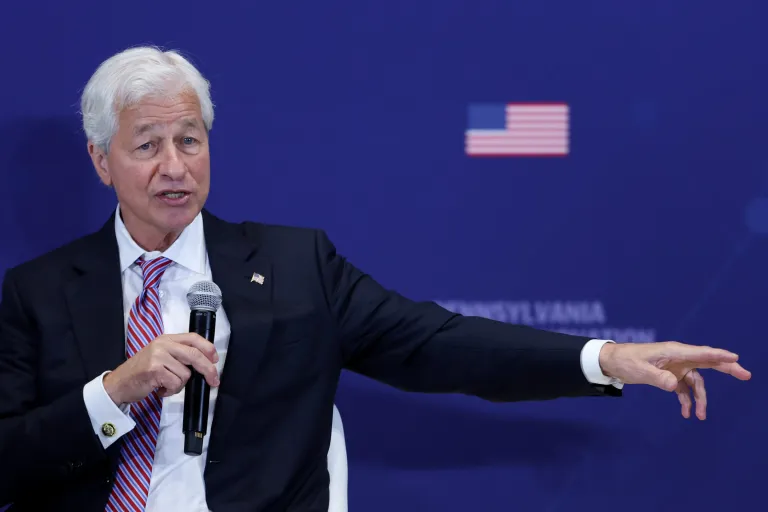
JPMorgan Chase chief executive Jamie Dimon has warned that the dollar’s position at the centre of global finance could weaken if the United States loses its economic and military supremacy over the coming decades.
Dimon argued that dollar reserve currency status cannot be separated from the wider power of the country issuing it. His comments add a national security dimension to a debate more commonly focused on government debt, financial markets, monetary policy and the emergence of alternative currencies.
Dimon Sets Out a 25-Year Test for US Power
Speaking to PBS over the weekend, Dimon framed the issue around the next quarter-century, arguing that both economic and military strength will matter if the US wants to preserve the dollar’s international role.
“If we’re not the strongest military in 25 years and the strongest economy, we won’t be the reserve currency either,” Dimon said. “The world will be fragmented, and it’ll be very dangerous for us.”
Daniel McDowell, associate director of Syracuse University’s Moynihan Institute of Global Affairs, told Fortune that economic strength remains the fundamental driver of a currency’s international position. Military capability can reinforce that advantage by increasing confidence in the security and durability of the country behind the currency.
A deterioration in US defence capabilities could affect that calculation in several ways. Allies that became less confident in Washington’s ability to protect either itself or its partners could reassess the strategic value of holding US assets, McDowell argued.
That relationship also extends to Treasury securities. Foreign governments and investors that buy US government debt help finance Washington, including the spending that supports American defence commitments. If those commitments became less credible, one incentive for allied countries to maintain close financial ties with the US could weaken.
McDowell also pointed to the potential consequences of a major military defeat. A decisive loss in a hypothetical large-scale conflict involving another major power could damage perceptions of US political and economic strength, with that reputational shock potentially affecting confidence in the dollar.
Reserve Currency Status Depends on More Than Military Reach
Military strength, however, is only one part of the dollar’s international appeal.
Eswar Prasad, a senior fellow in economic studies at the Brookings Institution, told Fortune that domestic institutions and economic dynamism matter more to reserve currency status than either the sheer size of an economy or its military capability.
Prasad said declining US economic and military power, combined with weaker domestic institutions and geopolitical influence, would damage dollar dominance. He also argued that the absence of a credible rival would make outright displacement difficult.
That distinction is important for investors. Reserve currency leadership does not depend simply on which country has the largest economy or military. International investors also need markets capable of absorbing enormous flows of capital, assets that can be bought and sold efficiently, and confidence that financial and legal institutions will remain dependable.
The dollar therefore benefits from advantages that would be difficult for a competitor to reproduce quickly. A challenge to its position could emerge gradually rather than through a sudden switch to another currency. Central banks, governments and companies could diversify more of their reserves, financing and trade into other currencies while continuing to use dollars extensively.
For markets, that means the more relevant question may not be whether the dollar suddenly loses its reserve status. The longer-term issue is whether its share of international finance erodes as governments seek greater currency diversification and strategic independence.
Investors Will Watch Institutions as Closely as Defence
Dimon’s warning puts the future of the dollar inside a broader debate over American power. Maintaining its global role will require more than military spending or economic scale alone. Confidence in US institutions, financial markets, economic performance and geopolitical commitments all contribute to the attractiveness of dollar assets.
The lack of an obvious replacement gives the US an important advantage, but it does not make the dollar’s position permanent. Investors will be watching whether Washington can preserve the combination of economic capacity, institutional credibility and security influence that has supported demand for US assets.
The long-term risk is therefore less about a single challenger replacing the dollar overnight and more about gradual fragmentation. If confidence in American power weakens, countries may have stronger reasons to spread reserves and financial exposure across a wider range of currencies and assets.