America’s largest technology companies are pouring hundreds of billions of dollars into artificial intelligence infrastructure, but an increasingly organised wave of local opposition is beginning to slow the industry’s most aggressive expansion plans.
Communities across the US blocked or delayed at least 48 data center developments worth an estimated $156bn during 2025, according to figures compiled by Data Center Watch, an initiative run by 10a Labs analyst Miquel Vila. The disputes highlight a widening clash between hyperscale cloud providers racing to secure AI computing capacity and residents concerned about electricity use, water consumption and tax incentives tied to the projects.
The tension arrives as Microsoft, Amazon Web Services, Meta, Alphabet, Oracle and CoreWeave sharply increase spending commitments tied to AI infrastructure and cloud expansion. Moody’s Ratings recently lifted its forecast for combined capital expenditure by the six groups to $785bn in 2026, with spending projected to approach $1 trillion in 2027.
Saline became a flashpoint for local resistance
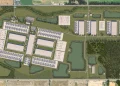
One of the clearest examples emerged in Saline, Michigan, where residents voted against plans linked to a proposed $16bn data center development. Despite the vote, construction activity moved ahead weeks later, reflecting the growing disconnect between local political resistance and the commercial urgency driving AI infrastructure investment.
Data Center Watch recorded a sharp rise in cancelled projects over the past year. Annual cancellations climbed from six developments in 2024 to 25 in 2025. More than 20 additional projects were halted during the first quarter of 2026 alone, placing the industry on pace for another record year of disputes.
Opposition groups are also spreading geographically. Vila’s research identifies 188 organised local campaigns operating across 40 states, many focused on concerns over industrial-scale water demand, increased strain on electrical grids and the impact of tax abatements granted to technology developers.
Public sentiment appears to be moving in the same direction. A recent Gallup survey found that 71% of Americans would oppose a data center project in their local area, a higher negative response than recorded for natural gas facilities or nuclear power plants.
Several state governments have started considering legislative restrictions. Maine lawmakers are weighing a proposal that would temporarily halt large-scale data center construction projects above 20 megawatts until late 2027, while Prince George’s County in Maryland has already imposed a development pause.
AI demand is keeping hyperscalers on the offensive
Despite the political friction, the largest cloud providers continue to expand aggressively because AI demand remains far ahead of available computing supply.
Moody’s said the three biggest hyperscalers collectively added around $700bn in contracted revenue backlogs across two quarters, supported by surging demand from AI developers including OpenAI and Anthropic. Google Cloud recently posted revenue growth of 63%, while AWS reported its fastest expansion rate in more than three years. Microsoft also disclosed AI-related revenue growth exceeding 120% year over year.
For investors, the scale of committed spending increasingly resembles a long-duration infrastructure cycle rather than a conventional technology upgrade. Consultancy McKinsey estimated earlier this year that global demand for AI-ready data center capacity could triple by 2030 as businesses integrate generative AI tools into software, finance, healthcare and manufacturing operations.
The financing structure behind the buildout also raises the stakes. Since September 2025, investment-grade hyperscalers have reportedly issued roughly $240bn in debt linked to infrastructure expansion. The sector’s three largest operators are also carrying more than $200bn in operating and finance lease obligations, with hundreds of billions more in lease commitments yet to commence.
That leaves developers exposed if permitting battles materially slow construction timelines. While hyperscalers currently view individual project cancellations as manageable, prolonged delays could create bottlenecks in regions already struggling to meet AI computing demand.
Semiconductor shortages may become the bigger constraint
For now, analysts still see hardware supply constraints as a larger immediate threat than local activism. Moody’s expects prices for memory components including DRAM and NAND to rise sharply through 2026 as AI-focused data centers consume a growing share of global semiconductor output.
Even so, the political trend is becoming harder for the industry to dismiss. Organised opposition groups are multiplying, state lawmakers are beginning to test restrictions, and communities that once welcomed industrial development are becoming more sceptical of the trade-offs tied to hyperscale facilities.
The next phase of the AI infrastructure race may depend less on access to capital and more on whether technology companies can persuade local governments and residents that the economic benefits outweigh the environmental and infrastructure costs. For an industry preparing to spend nearly $1 trillion within two years, that debate is becoming increasingly central to the future of AI expansion.