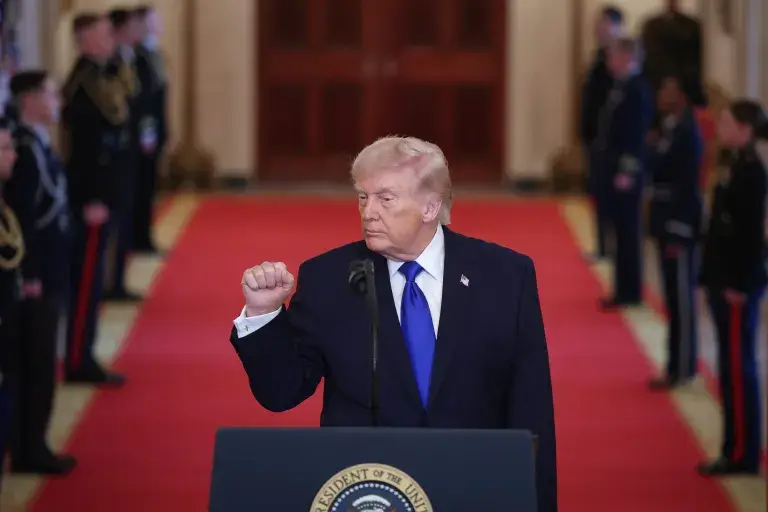
Hours before President Donald Trump was set to deliver his State of the Union address, a budget watchdog criticized Trump debt policy, warning that the United States faces historically high borrowing levels outside of wartime or national emergencies.
The Committee for a Responsible Federal Budget, a nonpartisan fiscal policy organization, issued a statement arguing that the administration’s economic agenda, including tariffs and tax cuts, risks deepening long-term structural deficits. The group’s president, Maya MacGuineas, said the country is now “more indebted than ever outside a war or emergency,” challenging the fiscal achievements the White House is expected to highlight in primetime remarks.
A Clash Over Tariffs and Revenue Projections
Tensions escalated after the Supreme Court ruled that the administration’s emergency tariffs, imposed under the International Emergency Economic Powers Act, were unlawful. The tariffs had been framed by the White House as both a trade policy tool and a source of federal revenue.
Following the decision, the Committee for a Responsible Federal Budget released an analysis estimating that the loss of those tariffs could reduce projected federal revenues by roughly $2 trillion over the next decade. Citing projections from the Congressional Budget Office, the group warned that federal debt could rise to 131 percent of GDP by 2036, compared with previous baseline projections of about 120 percent.
Treasury Secretary Scott Bessent rejected that assessment during a televised interview over the weekend. He argued that overall revenue levels would remain stable because the administration had moved swiftly to implement new tariffs under the 1974 Trade Act. Those measures began at 10 percent and were later increased to 15 percent.
Bessent criticized the watchdog’s methodology and defended the administration’s broader fiscal strategy. The exchange marked a sharp public disagreement between the White House and one of Washington’s most prominent fiscal policy groups.
MacGuineas responded by noting that her organization has previously supported the use of tariff revenues to strengthen the fiscal outlook. However, she emphasized that temporary trade measures cannot substitute for structural reforms, including spending reductions and revenue adjustments.
The Broader Fiscal Debate
The dispute over tariffs sits within a larger debate about the federal government’s long-term debt trajectory. According to recent Congressional Budget Office projections, debt levels are already on a steep upward path due to demographic pressures, rising healthcare costs, and interest expenses.
MacGuineas pointed to what she described as the structural impact of the administration’s domestic agenda, including the One Big Beautiful Bill Act, a signature legislative achievement of President Trump’s second term. The Congressional Budget Office has projected that the measure could add $4.2 trillion to the national debt through 2034. Longer-term projections from independent analysts suggest even larger cumulative effects over three decades.
Supporters of the legislation argue that its tax reductions and spending provisions will stimulate economic growth and expand the tax base. Critics counter that growth alone is unlikely to offset the scale of new borrowing, particularly as interest costs accelerate.
Interest Costs and Economic Implications
One of the watchdog group’s primary concerns centers on the cost of servicing the national debt. Current projections indicate that total interest payments could approach $17 trillion over the next decade. Annual interest expenses are expected to surpass $2 trillion by the mid-2030s.
High interest costs limit fiscal flexibility, potentially crowding out spending on defense, infrastructure, and social programs. Economists have also warned that sustained high debt levels can weigh on long-term economic growth, particularly if investors demand higher yields on Treasury securities.
As households continue to navigate inflation and retirement concerns, the fiscal outlook adds another layer of economic uncertainty. The Committee for a Responsible Federal Budget has urged policymakers to adopt a deficit target of 3 percent of GDP, strengthen Social Security and Medicare ahead of projected insolvency dates, and establish a bipartisan debt commission.
A Political and Economic Inflection Point
With the United States approaching its 250th anniversary, the debate over fiscal sustainability has taken on symbolic weight. For the administration, the State of the Union represents an opportunity to underscore economic resilience and growth. For fiscal watchdogs, it is a moment to highlight mounting structural risks.
The disagreement reflects a broader question facing lawmakers and investors alike, how to balance short-term economic stimulus with long-term fiscal responsibility. As borrowing continues to rise and interest costs mount, the trajectory of federal debt is likely to remain central to both policy debates and market sentiment in the years ahead.