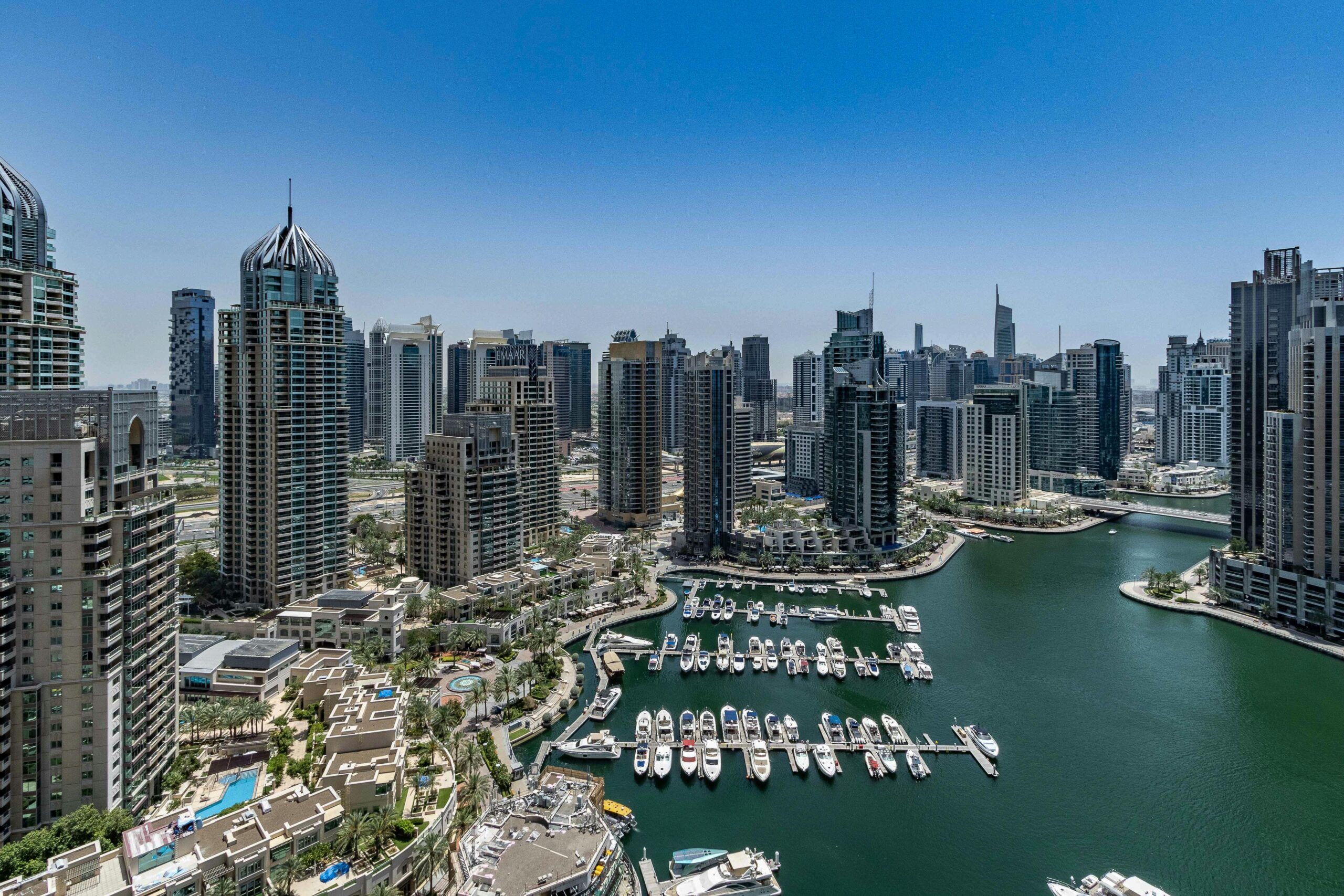
Dubai has spent the last two decades engineering itself into a destination for the globally mobile wealthy. The infrastructure is built for people who arrive with capital and want to be productive within weeks: world-class international schools, English as the working language, a tax regime that asks for nothing on personal income, and a residency framework — the UAE Golden Visa — that grants ten-year permits for property buyers, entrepreneurs, and skilled professionals.
What follows isn’t a ranking. It’s a guide to where families with the means to choose are actually choosing, and what you trade off in each direction.
The trophy address: Palm Jumeirah
The Palm remains the most internationally recognisable Dubai address. Frond villas on the outer arc start around AED 15 million and run to AED 100 million-plus for the largest plots. Apartments in towers like One at Palm and FIVE Palm Jumeirah trade between AED 5 million and AED 25 million.
You buy the Palm for direct beach access from your back garden, the visual recognition factor when overseas guests visit, and proximity to Atlantis, the cluster of beach clubs at the trunk, and the Bulgari Resort on its own peninsula a short drive away. You don’t buy the Palm for school proximity — every major international school is 25-40 minutes inland, which becomes a logistical reality during weekday school runs.
The Palm suits established families with grown or pre-school children, second-home buyers, and trophy-seekers. It suits less well families with children in the 7-16 age range when school commute times shape the day.
The discreet money: Emirates Hills and Dubai Hills
Emirates Hills is the closest thing Dubai has to old money, despite being barely twenty years old. Gated, golf course-centred, with villas set on plots of 12,000 to 30,000 square feet trading from AED 25 million upwards. The neighbours skew toward established business families, sovereign wealth executives, and quietly wealthy second-generation expats. There is no commercial activity within the compound, no through-traffic, and no visual statement-making — the houses are large but the architectural register is restrained by Dubai standards.
Dubai Hills, the newer Mohammed bin Rashid City development, is where families with school-age children have been moving since 2020. Villas at AED 8-25 million, apartments AED 2-6 million, a 1,500-acre central park, and — critically — three of Dubai’s strongest international schools (GEMS Wellington Academy, Dubai Hills Academy, GEMS International) within the development itself. The neighbourhood is family-led in a way Emirates Hills isn’t, with a meaningful supply of British, Australian, and South Asian families who relocated specifically for this combination.
The vertical play: Downtown Dubai and DIFC
For executives whose lives revolve around the financial district, Downtown and DIFC offer a different model: high-floor apartments with Burj Khalifa or Difc Gate Village views, walkable access to the office, and the heaviest concentration of fine dining in the city. Apartments in Burj Khalifa, The Address Residences, and Il Primo trade from AED 4 million to AED 30 million-plus.
The trade-off is straightforward: you give up garden, beach, and family scale for proximity and convenience. This works for single executives, couples without children, and second residences for families whose primary base is elsewhere.
Schools — the variable that ends most decisions
For families relocating to Dubai with school-age children, the school decision typically determines the neighbourhood, not the other way round. The most competitive admissions sit at:
- Dubai College (British curriculum, ages 11-18) — the oldest established school, consistently top exam results, very limited places.
- GEMS Wellington International (British, ages 3-18) — large, well-resourced, multiple sites.
- Dubai English Speaking College / DESS (British, primary and secondary) — strong reputation, oversubscribed.
- Dwight School Dubai (American + IB, ages 3-18) — newer, well-funded.
- Repton School Dubai (British, ages 3-18) — boarding option, sister school to Repton in the UK.
Annual fees range from AED 80,000 to AED 160,000 per child depending on age and school. Application timelines run 6-18 months ahead of intended start dates. Families relocating mid-year frequently find their preferred schools have no capacity in the relevant year group, which is why most professional relocation advisers start the school search before the property search.
Lifestyle and the rhythm of the city
Day-to-day life for HNW residents settles into recognisable patterns. Members’ clubs anchor much of the social infrastructure: Capital Club in DIFC for executives, Soho House Dubai in DIFC’s South area for the creative-leaning, the beach clubs at FIVE Palm and Twiggy for daytime social use. Nikki Beach is summer-shoulder season; in peak summer (June-September) most of social life moves indoors or to second homes in cooler latitudes.
Restaurant culture is dense and competitive. Zuma, Coya, Nobu, La Petite Maison, Il Borro, and Akira Back form the rotation for most expat HNW circles. Newer entrants — Marea, Carbone Dubai, La Mar — turn over reservations weeks in advance.
Dubai’s working week runs Monday to Friday since 2022, aligning with global markets. Friday brunch culture remains the dominant weekend social institution, particularly during the cooler months between October and April when outdoor dining is genuinely pleasant.
The practical realities
A few things people consistently underestimate before relocating:
Housing setup costs. Annual rents are typically paid in 1-4 cheques (one cheque is increasingly standard for premium villas, with discounts for upfront payment). Plan for 4 cheques worth of liquidity at lease start: rent, security deposit, agency commission (5%), and Ejari registration fee.
Utility transfers and Emirates ID. New residents need a Tenancy Contract (Ejari), Emirates ID, and DEWA (utilities) account before they can do basic things like open a bank account or buy a car. The chain takes 2-4 weeks to complete.
The summer reality. June through September is genuinely difficult — outdoor temperatures of 42-48°C, high humidity, and most outdoor venues closed. Established expat families typically schedule a 6-8 week absence during this window. Plan for it before committing to a multi-year lease.
Schools, again. I cannot overstate this. If a school decision is in play, it determines everything else.
The visa and tax angle
Most HNW relocations to Dubai are anchored by the UAE Golden Visa — a ten-year residence permit issued for property investments above AED 2 million (approximately €490,000), entrepreneurs, and qualifying professionals. The visa decouples residency from sponsorship by an employer, which suits internationally mobile families.
Holding the visa is not the same as becoming UAE tax-resident, however. The UAE applies a substance test that examines actual physical presence, family location, and centre of economic interests — and treaty partners increasingly challenge UAE tax residency claims that don’t reflect a genuine relocation. We’ve covered this in detail in our analysis of Dubai tax residency: the substance test you cannot afford to fail.
For families coordinating cross-border moves, our Tax Residency Calculator walks through the day-count tests for the UK, US, UAE, Portugal, and Singapore in parallel.
Who Dubai works for, and who it doesn’t
It works for: families with school-age children prioritising international curriculum and English-language education; entrepreneurs whose business activity is genuinely international and not tied to a single home market; HNW individuals leaving high-tax jurisdictions where the substance test for breaking residency requires genuine relocation; families wanting urban infrastructure with quick beach access.
It doesn’t work for: families with strong ties to a temperate climate or seasonal lifestyle; those whose income or business activity is rooted in a single overseas market with no realistic remote-management plan; HNW individuals seeking discreet, low-visibility lifestyle — Dubai is highly visible by design.
The decision usually clarifies itself once a family has spent two weeks in residence rather than two days as a guest.
Editorial content. Not legal, tax, or immigration advice. Consult a qualified professional before making relocation decisions.
Related coverage on Millionaire News: