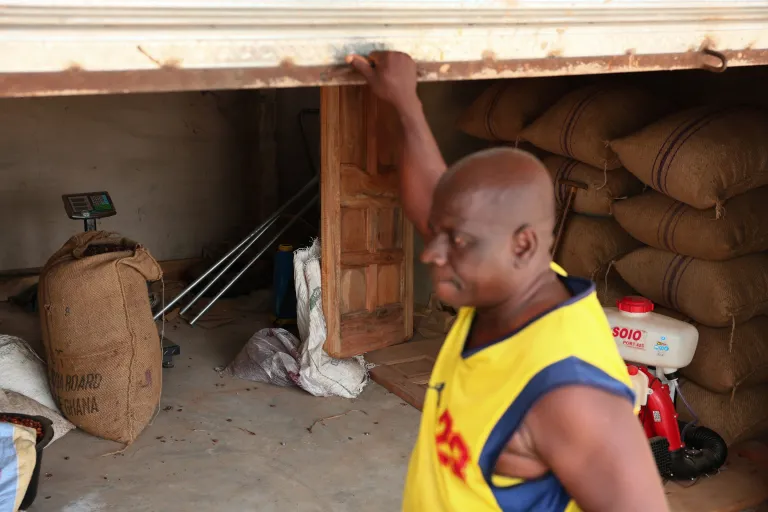
Cocoa stockpiles grow as prices plunge
African cocoa farmers are leaving harvests unsold and in some cases allowing beans to rot after a sharp collapse in global cocoa prices disrupted the world’s largest producing region.
Across Ghana and Ivory Coast, which together supply roughly 70 percent of the world’s cocoa, farmers say the steep downturn has left them unable to sell their crops profitably. Warehouses have filled with unsold cocoa beans while some farmers struggle to receive payments for harvests already delivered.
The situation highlights the fragile economics facing African cocoa farmers, many of whom depend almost entirely on the crop for their income.
Manu Yaw Fofie, a 52 year old farmer in Ghana, has watched the productivity of his cocoa land decline for years. His annual yield has fallen from roughly 300 bags in earlier years to about 50 bags in 2025.
With income shrinking, Fofie has begun leasing part of his land to illegal sand miners, a practice driven by strong demand from the construction sector. Sand is a key ingredient in concrete and can generate faster returns than cocoa farming.
The decision carries long term risks. Sand mining strips nutrients from the soil and can leave farmland infertile. Still, Fofie said the economic pressure left him few alternatives.
A dramatic swing in cocoa futures
The current crisis follows an extreme price cycle in global cocoa markets. Cocoa futures surged during 2024, reaching more than $12,000 per metric ton, one of the highest levels in decades. The rally was fueled by tight supplies and growing concerns about weather related crop losses.
But the market reversed quickly as production and supply conditions shifted. Prices later dropped to around $4,000 per metric ton, creating major disruptions for traders and exporters.
For farmers in West Africa, the sudden shift proved particularly damaging because cocoa pricing systems in Ghana and Ivory Coast rely heavily on government regulated purchasing structures.
Authorities set a fixed price for farmers at the beginning of the season. While the policy is designed to protect producers from market volatility, it also meant many farmers did not benefit when international prices briefly surged.
When the market later collapsed, global traders found it difficult to purchase cocoa at government set prices without incurring losses. As a result, cocoa shipments slowed and inventories accumulated.
Some farmers who had already delivered their beans to government buyers say they have waited months to receive payment.
Edward Karaweh, a former general secretary of the General Agricultural Workers Union, said the scale of the downturn caught policymakers off guard.
Preparation can help reduce the impact of commodity cycles, he said, but the speed and magnitude of the price collapse created a crisis that regulators struggled to manage.
Climate stress compounds farmers’ struggles
Environmental pressures are also weakening cocoa production across the region.
In Ivory Coast, farmer François N’Gbin pointed to cocoa pods on his trees that had blackened and dried prematurely, signs of disease and prolonged dry conditions.
Climate change, irregular rainfall patterns and crop diseases have all contributed to declining yields in recent years.
Facing shrinking harvests and lower prices, N’Gbin said he allowed part of his land to be used for small scale gold mining. The activity now covers about 1,000 square meters of his farm.
“Today gold is more profitable than cocoa,” he said, noting that the income from small gold finds can exceed what farmers earn from cocoa beans.
Farmers’ groups say similar decisions are becoming increasingly common as households search for alternative income sources.
Moussa Koné, president of the Ivorian cocoa farmers union, said many farmers are leasing land to informal miners or shifting to other activities simply to maintain their livelihoods.
“Cocoa is not selling, but farmers still need money to feed their families,” he said.
Governments attempt to stabilize the sector
Authorities in both Ghana and Ivory Coast have begun adjusting policies in an attempt to restore market balance.
Ghana recently reduced its official cocoa price by about 28 percent to make exports more competitive and attract international buyers.
Ivory Coast also cut the price paid to farmers for the 2026 season by more than half, setting it at 1,200 CFA francs per kilogram.
While the measures are designed to restart trade flows, farmers say the new prices leave very narrow profit margins once production costs are considered.
Mercy Amponsah, a cocoa farmer in Ghana, warned that the reduced price threatens household stability. She joined other farmers in protests in Accra earlier this year.
Accepting the lower price could mean difficult choices for families, including whether children can continue attending school, she said.
Outside West Africa, cocoa production in regions of South America and Asia has expanded in recent years, providing some additional supply to global markets. However, West Africa still dominates the industry.
For farmers like Fofie, the future of cocoa farming remains uncertain.
“If I keep this cocoa farm for the next 10 years,” he said, “I would die a poor man.”