Echoes of the 1970s, Are Markets Facing Another Oil Shock?
Concerns about a potential stock market meltdown risk are rising as global oil prices surge and economic indicators soften, reviving comparisons to the stagflation era of the 1970s.
Market strategist Ed Yardeni, president of Yardeni Research, recently raised his estimate for the probability of a severe market downturn accompanied by stagflation to 35% in 2026, up from 20% previously. The warning reflects a combination of geopolitical tensions, weakening labor market data, and slowing economic growth.
The catalyst behind the renewed anxiety is the ongoing conflict involving Iran, which has disrupted shipping through the Strait of Hormuz, a narrow passage that handles roughly one fifth of the world’s crude oil supply. Attacks on oil tankers in the region have pushed crude prices above $100 per barrel, raising concerns about inflationary pressure across the global economy.
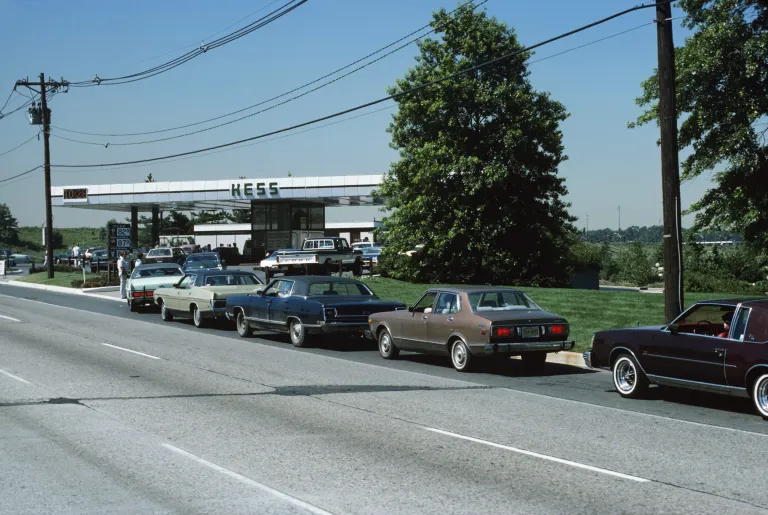
The situation carries uncomfortable historical parallels. The oil shocks of the 1970s, triggered by geopolitical tensions in the Middle East, contributed to a period marked by rising prices, stagnant economic growth, and persistent unemployment, the combination known as stagflation.
Iran Conflict Puts Pressure on Energy Markets
The latest spike in oil prices stems from attacks linked to Iran’s Islamic Revolutionary Guard Corps targeting tankers passing through the Strait of Hormuz. The disruption has effectively created a partial blockade in one of the world’s most critical energy corridors.
Western governments are considering releasing strategic oil reserves to stabilize supply, and the United States has authorized naval escorts for commercial vessels navigating the strait. However, Yardeni noted that the effort may take time to implement and may not fully eliminate the threat of drone attacks.
As long as the shipping corridor remains vulnerable, energy markets are likely to remain volatile. Higher fuel costs ripple through transportation, manufacturing, and consumer goods, potentially reigniting inflation at a time when economic growth is already showing signs of slowing.
Economic data has added to the uncertainty. The most recent U.S. jobs report revealed an unexpected decline in employment, extending a trend of minimal net job gains over the past year. At the same time, forecasts for first quarter gross domestic product growth have been revised downward to 2.1%, compared with earlier projections of 3.2%.
These developments raise the possibility that the global economy could face a difficult mix of slowing growth and rising prices, conditions that historically weigh heavily on financial markets.
“Between Iran and a Hard Place”, The Federal Reserve’s Dilemma
According to Yardeni, policymakers now face a complicated balancing act. If oil prices remain elevated, the Federal Reserve may be forced to choose between addressing rising inflation and responding to a weakening labor market.
This dilemma reflects the central bank’s dual mandate of maintaining price stability while supporting maximum employment. An energy-driven inflation spike could make it harder for policymakers to ease monetary policy, even if economic momentum slows.
Oil shocks have historically coincided with recessions, although not always. Yardeni pointed to the aftermath of Russia’s invasion of Ukraine in 2022, when energy prices surged but the U.S. economy ultimately avoided a downturn.
Part of the resilience comes from structural changes in the energy sector. The United States is now the world’s largest oil producer and relies less on imports than in previous decades. This shift has reduced the economy’s vulnerability to global supply disruptions.
Roaring 2020s or Stagflation, Two Competing Futures
Despite the heightened stock market meltdown risk, Yardeni’s base case remains relatively optimistic. He continues to assign a 60% probability that the economic expansion of the “Roaring 2020s” will continue.
However, he reduced the probability of a rapid market surge, or “meltup,” to just 5%, down sharply from 20%. Instead, he sees a greater chance of a moderate correction in equity markets.
Under this scenario, stocks could decline between 10% and 15% before stabilizing, rather than entering a full bear market defined by losses exceeding 20%.
Looking further ahead, Yardeni’s longer term outlook for the remainder of the decade focuses on two primary outcomes. He assigns an 85% probability to continued economic expansion and a 15% probability to a prolonged stagflation environment similar to the 1970s.
Another risk could emerge if disruptions in the Strait of Hormuz continue into the spring. The Gulf region is also a major exporter of fertilizer, and shipping delays could force farmers to reduce fertilizer usage or seek alternatives.
Lower fertilizer application can lead to weaker crop yields, raising the possibility of a secondary surge in global food prices later in 2026.
For investors, the key turning point may be whether shipping routes through the Strait of Hormuz can return to normal operations. If tanker traffic resumes safely, Yardeni believes the current bull market could regain momentum.
Until then, geopolitical tensions and energy market volatility are likely to remain central drivers of market sentiment.