Markets react as oil prices surge past $100
Global financial markets opened the week under pressure after oil prices surge past $100, reflecting mounting concerns that the escalating conflict involving Iran could disrupt energy supplies and prolong geopolitical instability.
U.S. oil futures jumped more than 17 percent to around $106 per barrel, while Brent crude rose more than 15 percent to a similar level. The surge pushed crude above the $100 threshold for the first time since 2022, raising concerns about renewed inflation and higher fuel costs for consumers.
The market reaction extended beyond commodities. Futures tied to the Dow Jones Industrial Average fell roughly 900 points in early trading, while S&P 500 and Nasdaq futures also declined sharply. Investors increasingly appear to be pricing in a prolonged conflict rather than a short military operation.
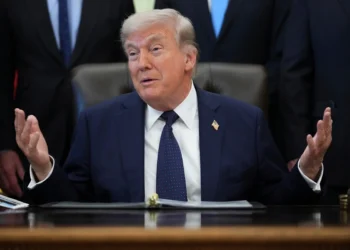
President Donald Trump addressed the oil spike over the weekend, suggesting that higher energy prices could be a temporary cost tied to broader security goals. In a social media post, he argued that the economic impact would fade once the perceived nuclear threat from Iran is resolved.
Energy infrastructure and supply routes under pressure
The sharp rise in crude prices reflects growing concern about disruptions to one of the world’s most important energy corridors. The Strait of Hormuz, a narrow passage between Iran and the Arabian Peninsula, has effectively halted oil shipments from several Gulf producers.
The waterway normally carries a significant portion of the world’s oil exports. With shipping routes restricted, producers across the region are facing logistical challenges that limit their ability to move crude to global markets.
In Iraq, oil output has reportedly dropped by about 60 percent as storage capacity fills and exports stall. Other Gulf states have also faced attacks on critical infrastructure, further intensifying supply concerns.
Beyond oil, desalination facilities in the region have also been targeted. Countries across the Middle East depend heavily on desalination plants to produce fresh water from seawater. Damage to these systems could pose serious humanitarian risks if water supplies become constrained.
Escalating military actions deepen uncertainty
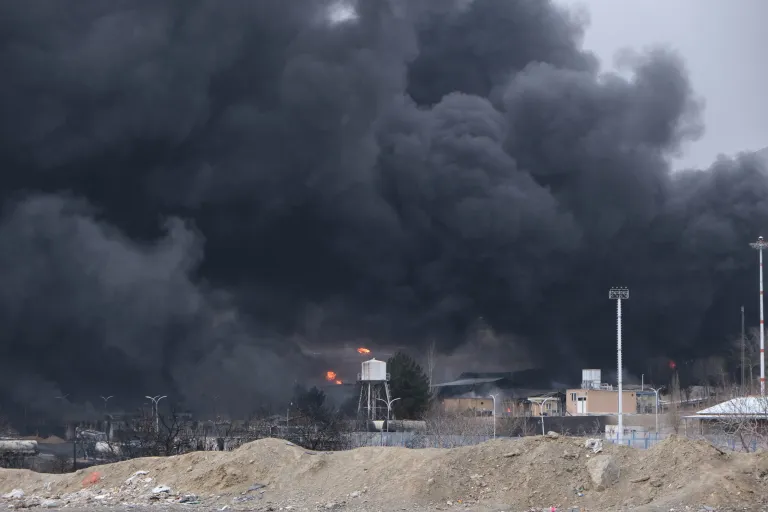
The military confrontation has expanded rapidly in scope. U.S. and Israeli forces recently targeted an oil depot in Tehran, a facility believed to support both civilian and military supply networks. The strike reportedly triggered large fires and widespread smoke across parts of the Iranian capital.
Iran has responded with missile and drone attacks aimed at energy facilities and infrastructure around the Persian Gulf. The cycle of retaliation has heightened fears that additional countries could become directly involved in the conflict.
The Pentagon confirmed that another U.S. service member was killed in recent fighting, bringing the total number of American casualties in the conflict to seven. Meanwhile, reports indicate that U.S. officials are considering a potential special forces mission aimed at securing highly enriched uranium believed to be close to weapons grade.
Such an operation would represent a major escalation and could draw further responses from Iran or its regional allies.
Leadership change in Iran signals hardline stance
Political developments inside Iran have also added to uncertainty surrounding the conflict. Authorities announced that Mojtaba Khamenei, the son of Iran’s longtime supreme leader Ayatollah Ali Khamenei, is expected to assume the country’s top leadership role following his father’s death.
The succession has been interpreted by many analysts as a signal that hardline factions remain firmly in control of Iran’s political establishment. Observers believe this could reduce the likelihood of a near-term diplomatic compromise with the United States or its allies.
President Trump previously indicated skepticism toward the leadership transition, stating that Iran’s next leader should prioritize stability and peace rather than confrontation.
For global markets, the immediate concern remains the possibility of a prolonged conflict that disrupts energy supplies and accelerates inflation. If oil prices remain above $100 for an extended period, economists warn that higher fuel and transportation costs could ripple across global supply chains and consumer prices.
With geopolitical tensions still rising, investors are likely to watch both military developments and energy markets closely in the weeks ahead.