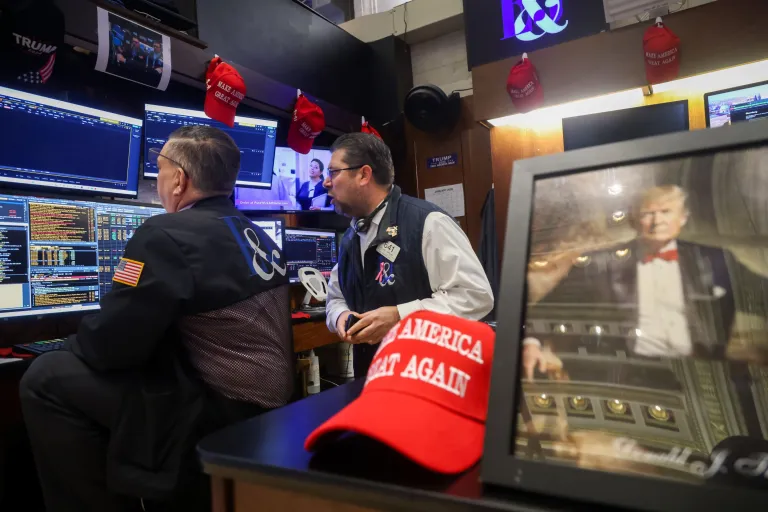
U.S. equity futures slid sharply late Monday as investors reacted to fresh trade tensions between Washington and its closest allies. Dow futures fall as Trump tariffs hit NATO allies, reviving fears of another disruptive trade conflict even as Wall Street clings to expectations of eventual de-escalation.
Futures linked to the Dow Jones Industrial Average dropped more than 400 points, while S&P 500 and Nasdaq futures also declined. The moves came during a U.S. market holiday, amplifying concerns that global investors were reassessing the safe haven status of American assets amid rising geopolitical uncertainty.
A tariff threat tied to Greenland ambitions
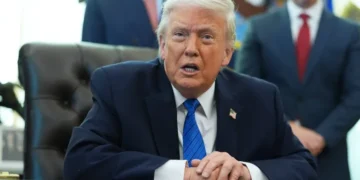
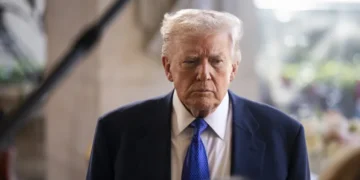
The selloff followed weekend remarks by Donald Trump, who announced new tariffs targeting several European countries that are members of North Atlantic Treaty Organization. The proposed measures include a 10 percent levy beginning February 1, escalating to 25 percent by June 1 unless a deal is reached related to U.S. ambitions over Greenland.
The affected countries include Denmark, Norway, Sweden, France, Germany, the United Kingdom, the Netherlands, and Finland. The announcement followed reports that European troops had been deployed to Greenland for training exercises at Denmark’s request, a move that added a security dimension to an already fraught diplomatic dispute.
The linkage of trade policy to territorial and political grievances has unsettled markets, particularly in Europe. Stocks across major European and Asian exchanges retreated earlier Monday, while the U.S. dollar weakened as investors questioned the reliability of American policy signals.
Markets closed, nerves open
With U.S. cash markets closed for the Martin Luther King Jr. Day holiday, futures trading offered one of the few real-time gauges of investor sentiment. The sharp drop suggested that traders were positioning defensively ahead of a potentially volatile week.
Some strategists warned that escalating tariffs against Europe could strain the transatlantic alliance at a delicate moment, especially as Europe continues to support Ukraine’s defense against Russia. From a market perspective, the risk is that trade restrictions could disrupt supply chains, dampen corporate earnings, and complicate central bank policy decisions on both sides of the Atlantic.
Is this another negotiating tactic?
Despite the initial shock, many analysts urged caution against assuming a prolonged trade war. Michael Brown, senior research strategist at Pepperstone, described the move as a classic escalation designed to force talks rather than a permanent shift in policy.
He noted that the timing of the announcement, just days before Trump’s scheduled appearance at the World Economic Forum in Davos, suggested a calculated attempt to gain leverage on the global stage. Markets, he argued, may face short-term turbulence driven by headlines, followed by relief if talks progress.
The view echoes a broader belief on Wall Street that investors have become more adept at filtering political noise from economic fundamentals. While volatility may rise, many expect any severe selloff to be temporary.
Why investors still see limits to escalation
Jonas Goltermann, deputy chief markets economist at Capital Economics, downplayed the likelihood of a repeat of last year’s tariff-driven turmoil. He pointed out that the U.S. economy remains resilient, corporate balance sheets are relatively strong, and markets still have buffers against external shocks.
According to Goltermann, both the U.S. and Europe possess the ability to inflict economic pain through trade measures, but only at significant cost to themselves. That mutual vulnerability, he argued, makes compromise the more probable outcome over time.
For now, Dow futures fall as Trump tariffs hit NATO allies, serving as a reminder of how quickly geopolitical developments can ripple through global markets. Investors are likely to remain cautious in the days ahead, balancing headline risk against the assumption that cooler heads, and negotiated settlements, will ultimately prevail.