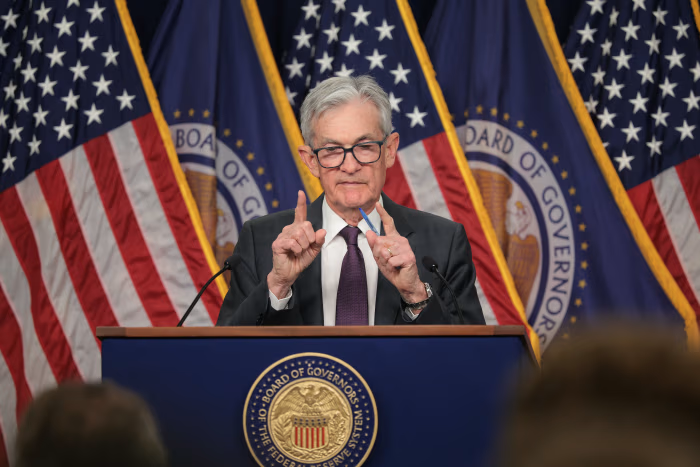
Jerome Powell, chair of the Federal Reserve, issued a rare and forceful rebuke of the Trump administration, warning that a Justice Department criminal probe represents a direct challenge to Federal Reserve independence. In a statement released Sunday, Powell said the investigation stems from the central bank’s refusal to lower interest rates earlier in the year, despite repeated demands from President Donald Trump.
The remarks mark one of the clearest public defenses of Federal Reserve independence in recent years, and underscore rising tensions between monetary policymakers and the White House. Powell framed the issue as one with broad economic consequences, not a personal dispute, arguing that political pressure on interest rate decisions threatens the credibility of US economic governance.
A criminal probe tied to policy decisions
Powell said the Department of Justice has served the Federal Reserve with grand jury subpoenas that could lead to criminal charges against him. The inquiry formally centers on Powell’s testimony to the Senate last June regarding renovations to the Fed’s Washington headquarters, a project that has experienced cost overruns.
According to Powell, those issues are not the true focus of the investigation. He described the renovation questions and his testimony as “pretexts,” asserting that the probe is retaliation for the Fed’s decision to maintain higher interest rates in the face of political pressure.
“The threat of criminal charges is a consequence of the Federal Reserve setting interest rates based on our best assessment of what will serve the public,” Powell said, rather than complying with the preferences of the president.
The Federal Reserve raised rates aggressively to combat inflation and has been cautious about easing policy, citing persistent price pressures and labor market conditions. That stance has put Powell at odds with President Trump, who has publicly criticized the Fed for not cutting rates sooner.
Why Federal Reserve independence matters
Powell emphasized that the issue goes beyond his own position, describing it as a test of whether monetary policy in the United States will continue to be guided by economic data or by political intimidation. Federal Reserve independence is widely viewed by economists as essential to maintaining price stability, managing inflation expectations, and preserving confidence in financial markets.
“This is about whether the Fed will be able to continue to set interest rates based on evidence and economic conditions,” Powell said, or whether policy decisions will instead be shaped by political threats.
Markets have historically reacted negatively when central bank independence is questioned, particularly in emerging economies. While the United States has long been seen as insulated from such risks, the current dispute has drawn renewed attention to the institutional safeguards protecting the Fed.
Powell’s record across administrations
Powell noted that he has served under both Republican and Democratic presidents without favoring any political agenda. Appointed as Fed chair during the first Trump administration and later reappointed, Powell has often stressed the central bank’s dual mandate of price stability and maximum employment.
He said his approach to leadership has remained consistent regardless of the political environment, and that the Fed’s decisions are driven by economic analysis rather than partisan considerations.
“Public service sometimes requires standing firm in the face of threats,” Powell said, adding that he intends to continue carrying out the responsibilities entrusted to him by the Senate confirmation process.
Broader implications for markets and governance
The confrontation raises broader questions about the relationship between the executive branch and independent regulatory institutions. Analysts note that even the perception of political interference can influence bond markets, currency stability, and investor confidence.
While the Justice Department has not publicly commented on the substance of Powell’s claims, the episode is likely to intensify debate in Congress over the limits of executive power and the protections afforded to independent agencies.
For now, Powell’s statement signals that the Federal Reserve leadership is prepared to publicly defend its autonomy, even at personal and institutional risk. How the dispute unfolds could shape expectations about US monetary policy credibility for years to come.