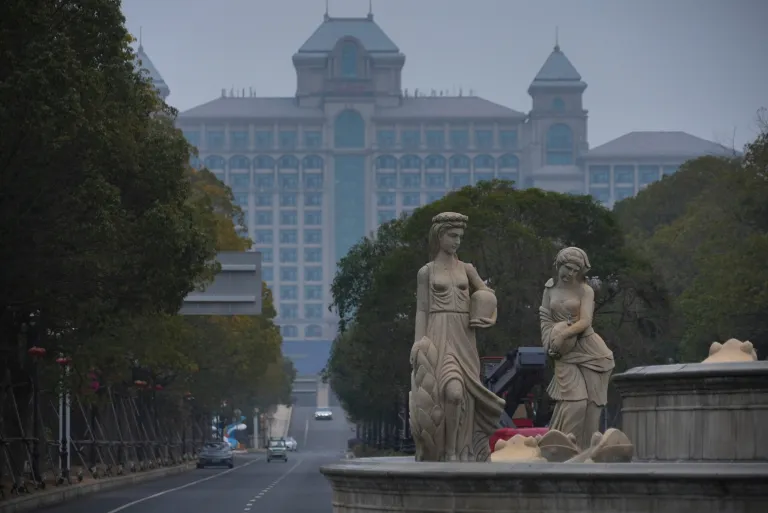
On China’s eastern coast, a sprawling replica of Venice is attracting an unexpected demographic. Young professionals retire early in China’s faux Venice, trading high salaries and urban ambition for low living costs and personal freedom.
The development, known as Life in Venice, sits in Qidong, Jiangsu province. Built as a luxury seaside escape for affluent buyers from nearby Shanghai, the complex now stands largely empty. Property prices have fallen sharply in recent years, creating an unusual opportunity for young professionals retire early in China’s faux Venice and step away from demanding careers.
From 700,000 Yuan Salary to Financial Independence
Sasa Chen, 28, once earned up to 700,000 yuan annually, about 98,000 dollars, in Shanghai’s finance sector. After three years in a high-pressure environment, she decided to leave. She saved roughly 2 million yuan and relocated to Life in Venice, where she rents an apartment for 1,200 yuan a month, around 168 dollars.
For Chen, the math was straightforward. With low rent and modest daily expenses, she believes her savings and investment returns can sustain her indefinitely. A simple meal in the area costs less than three dollars, and essential services remain accessible despite the project’s partial abandonment.
She describes her new routine as unhurried. Late mornings, home cooking, long walks along the shoreline, and time for reflection have replaced corporate deadlines. Her decision reflects a broader reassessment among China’s young professionals about the meaning of work and the cost of ambition.
A Property Dream That Unraveled
Life in Venice was developed by China Evergrande Group during the early 2010s property boom. The project envisioned canals, European-style architecture, and a coastal resort atmosphere for weekend homeowners.
That vision unraveled after China’s debt-fueled property expansion stalled. As the real estate market contracted, demand evaporated. Evergrande entered bankruptcy proceedings in 2024, leaving many large-scale projects unfinished or under-occupied.
At Life in Venice, fewer than 20 percent of the 46,000 units are occupied. Empty storefronts line the streets, and many villas remain unfinished shells. Yet for a small but growing group of residents, the underused infrastructure provides affordable space and relative tranquility.
Home prices in the development have more than halved since the market downturn. For buyers and renters willing to accept distance from major employment hubs, the cost advantage is compelling.
Escaping 996 and Redefining Success
China’s urban workforce has long been defined by the so-called 996 culture, working from 9 a.m. to 9 p.m., six days a week. The demanding schedule is common in technology and finance sectors, especially in cities like Shanghai and Beijing.
As economic growth moderates, competition for top roles has intensified. China’s economy expanded by 5 percent in 2025, solid by global standards but well below the double-digit growth rates of previous decades. Youth unemployment remains elevated, and career progression appears less certain than in the past.
Between 2019 and 2024, Beijing’s population of people in their twenties and early thirties fell by 1.6 million, according to official statistics. Analysts view this shift as part of a broader recalibration.
Xiang Biao, director of the Max Planck Institute for Social Anthropology in Germany, has described the movement as a rejection of linear career expectations. Rather than pursuing constant upward mobility, some young people are prioritizing flexibility and mental well-being.
In some cases, this trend intersects with global ideas such as financial independence and early retirement. Lower living costs in smaller Chinese cities make such strategies more attainable than in many Western markets.
Bargain Cities and New Lifestyles
Beyond Qidong, other regions are drawing similar interest. In Hegang, a former coal mining city in northeastern China, housing prices have fallen so dramatically that small apartments can cost less than a compact car. As mines closed and residents departed, excess housing supply pushed prices to historic lows.
Real estate agents in the area report buyers from across the country, including young professionals seeking inexpensive ownership options. The affordability allows residents to reduce working hours or pursue remote income streams.
The trend also extends to smaller towns in provinces such as Yunnan, where low rents and scenic surroundings appeal to urban migrants seeking balance. For many, the decision reflects both economic calculation and a cultural shift.
A Structural Shift or a Temporary Retreat
Finance professor Chen Zhiwu of the University of Hong Kong argues that high living costs in major cities, combined with slowing growth, are naturally encouraging geographic redistribution. As job prospects tighten and property values adjust, relocation becomes a rational choice.
Whether this marks a lasting demographic transformation remains uncertain. Major cities continue to host the majority of high-value industries, innovation centers, and global capital flows.
For now, however, the phenomenon is visible. Young professionals retire early in China’s faux Venice not as a symbol of retreat, but as an expression of new priorities. In an economy adjusting to slower growth, ambition is no longer defined solely by salary or skyline views. For some, it is measured in time, autonomy, and sustainability.