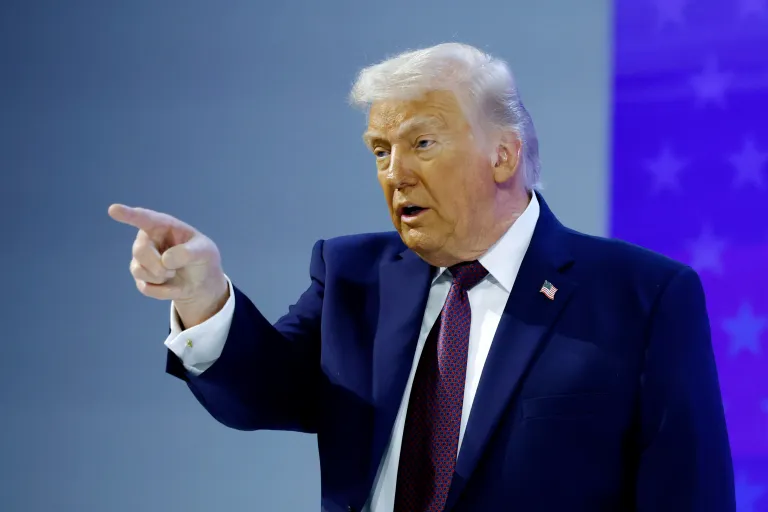
When President Donald Trump talks about the federal debt, his answer is consistent. Growth, not austerity, is the solution. At the World Economic Forum in January, Trump argued that a faster expanding economy would generate enough tax revenue to shrink deficits and eventually reduce the national debt. “We’re going to be growing our way out,” he said.
The problem is that Trump’s own signature legislation, the One Big Beautiful Bill, may be moving the country in the opposite direction. According to estimates from the nonpartisan Committee for a Responsible Federal Budget, the bill could add roughly $5.5 trillion to federal deficits over the next decade if its provisions are extended as expected. That increase alone raises the bar for the kind of economic growth required to stabilize the nation’s finances.
Growth as the centerpiece of Trump’s fiscal vision
Trump’s economic strategy rests on a familiar premise, rapid growth can ease the burden of high debt. His administration has tied that vision to aggressive deregulation, incentives for domestic manufacturing, and heavy investment in artificial intelligence infrastructure. The White House has highlighted massive data center projects and new factory construction as signs that productivity is poised to accelerate.
Under current projections from the Congressional Budget Office, however, the U.S. economy is expected to grow at a modest pace, roughly 1.8 percent annually after inflation. Including inflation, that translates to about 3.8 percent nominal growth. Those assumptions already imply rising deficits, largely because spending on interest, health care, and retirement programs grows faster than revenues.
Trump’s argument is that these forecasts are too pessimistic, and that a productivity boom can push growth significantly higher. The question is how much higher growth would need to be to offset the fiscal impact of his policies.
Why the Big Beautiful Bill changes the math
The One Big Beautiful Bill extends and expands tax cuts from Trump’s first term, adds new deductions for workers and consumers, and allows businesses to immediately expense investments in equipment, plants, and software. It also increases spending on defense and immigration enforcement. While many of these measures are scheduled to expire, budget analysts widely expect Congress to renew them.
The CRFB’s alternative scenario assumes that extension happens. Under that view, deficits widen sharply over the next decade. By 2035, annual shortfalls could approach $3.5 trillion, close to 8 percent of GDP, with federal debt climbing to more than 130 percent of economic output. Interest costs alone would exceed $2.5 trillion a year, consuming a growing share of federal spending.
In short, before the bill, Trump’s growth-first strategy faced a steep climb. After it, the climb becomes significantly steeper.
What if growth really accelerates?
To test Trump’s thesis, consider a more optimistic scenario. If the U.S. managed to grow at 3 percent annually in real terms, closer to the pace seen in the 1990s, revenues would rise much faster. Under that assumption, deficits by 2035 could fall below 5 percent of GDP, and the gap between spending and revenues would narrow substantially.
That outcome would ease pressure on borrowing and slow the rise in interest costs. It would not, however, eliminate the debt problem. Even with faster growth, federal debt would likely remain above 100 percent of GDP, and interest payments would still be far higher than today.
Policy experts caution that sustaining 3 percent growth would be extraordinarily difficult. Demographic trends point to slower labor force expansion, and higher incomes often bring higher costs for programs like Medicare and Social Security. As Brookings Institution budget analyst Jessica Riedl has noted, growth alone may offer temporary relief but is unlikely to solve the problem over the long term.
A narrowing set of options
The broader risk is confidence. Investors financing U.S. debt will be watching whether growth accelerates quickly enough to justify rising borrowing. If they lose faith, interest rates could rise further, worsening the deficit outlook.
That leaves policymakers with uncomfortable alternatives, including broad-based tax increases such as a value-added tax, a tool widely used in Europe but long resisted in the United States. Ironically, that would move the U.S. closer to fiscal models Trump has often criticized abroad.
For now, Trump continues to bet that growth can outrun debt. The numbers suggest that his own Big Beautiful Bill makes that bet far more precarious.