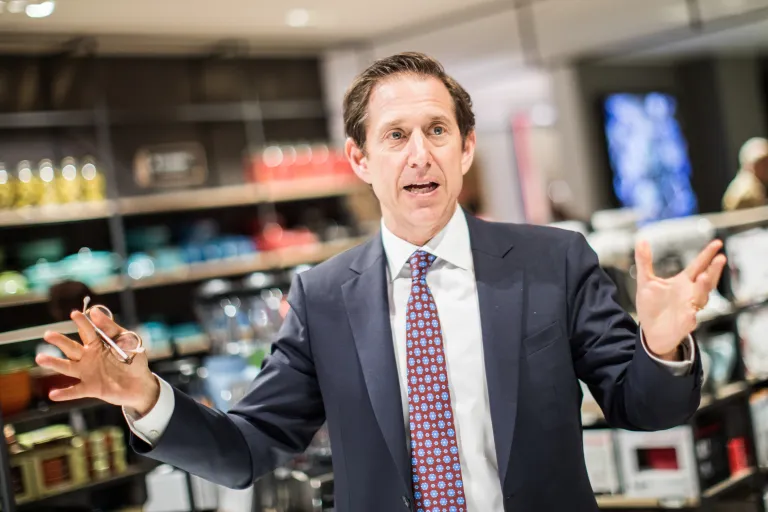
The Saks Global crisis is rapidly becoming one of the most consequential cautionary tales in modern luxury retail. At the center of it is Richard Baker, a real estate heir whose long history of aggressive dealmaking has left a trail of weakened department store brands. Now, as Saks Global grapples with missed debt payments and shrinking inventory, the company is edging closer to bankruptcy court.
Baker, who recently stepped into the CEO role after the resignation of Marc Metrick, oversees a portfolio that includes Saks Fifth Avenue, Neiman Marcus, and Bergdorf Goodman. The 2024 merger that united these brands was pitched as a bold consolidation play. Instead, it has exposed deep structural flaws in a business already under pressure.
A pattern of deals that hollowed out retailers
Baker’s reputation in retail circles is shaped less by operational turnarounds and more by financial engineering. Over the past two decades, he has acquired storied department store chains only to see many of them decline sharply. Lord & Taylor, purchased in 2006, was sold in 2019 in diminished form before its physical stores shut down. Hudson’s Bay in Canada, once a 355 year old retail institution, was liquidated last year.
Even digital ventures failed to deliver lasting value. The acquisition of Gilt Groupe ended with a loss, and overseas expansion efforts in the Netherlands collapsed within two years. These experiences foreshadowed the challenges now engulfing Saks Global.
The Saks Neiman merger, scale without strength
The $2.65 billion Saks Neiman Marcus deal was designed to create a dominant U.S. luxury department store group with increased leverage over vendors and landlords. The combined company was expected to unlock efficiencies and capitalize on valuable flagship real estate.
Instead, overlapping store footprints and changing consumer behavior undermined the thesis. Luxury brands increasingly favor direct to consumer models, reducing reliance on department stores. At the same time, the merged company carried heavy debt loads, limiting its ability to invest in merchandise, staff, and store experience.
By late 2025, the strain was visible. Saks Global missed a $100 million interest payment and began negotiating emergency financing. Revenue fell 13% year over year in the second quarter, while inventory shortages became impossible to ignore.
When cash preservation erodes the luxury promise
Nothing damages a luxury retailer faster than empty shelves. In an effort to conserve cash, Saks Global stretched vendor payments to as long as 12 months, prompting many suppliers to reduce or halt shipments altogether. Analysts later described the company’s inventory position as inadequate.
Cost cutting also chipped away at brand equity. Saks skipped its iconic Fifth Avenue holiday light show in 2024, disappointing shoppers and tourists. The closure of Neiman Marcus’s downtown Dallas flagship sparked such backlash that the decision was reversed, highlighting misjudgments in understanding customer loyalty.
Meanwhile, competitors seized the moment. Bloomingdale’s and Nordstrom invested in store experience and maintained strong vendor relationships, posting solid sales growth as Saks Global stumbled.
Financial engineering versus retail fundamentals
The roots of the Saks Global crisis lie in a strategic bias toward real estate value rather than retail fundamentals. Baker’s family fortune was built in shopping mall development, and that perspective shaped decisions such as spinning off Saks’ digital business in 2021 in pursuit of a tech style valuation.
Yet retail experts argue that separating e commerce from physical stores weakened the brand ecosystem. At the same time, monetizing prime real estate proved harder than expected, as large downtown properties require significant capital and lack liquidity.
Now Baker faces the task of stabilizing the business without the merchandising background typical of successful retail CEOs. A Chapter 11 filing would not mean liquidation, but it could result in fewer stores and deeper vendor mistrust.
An uncertain path forward
Analysts agree that excessive debt has become the defining threat. Without restoring supplier confidence and reinvesting in the customer experience, Saks Global risks long term erosion, even if it survives bankruptcy.
Whether U.S. luxury shoppers return in force remains uncertain. What is clear is that the Saks Global crisis underscores a broader lesson for retail, scale and real estate alone cannot substitute for strong inventory, healthy vendor relationships, and a compelling in store experience.