A 2,000-year lens, or a warning for today?
A long-term view of global economic history is reshaping how investors interpret today’s geopolitical and market dynamics. A recent analysis drawing on a 2,000-year dataset suggests the current China global economic power shift may not be a disruption, but a return to historical norms.
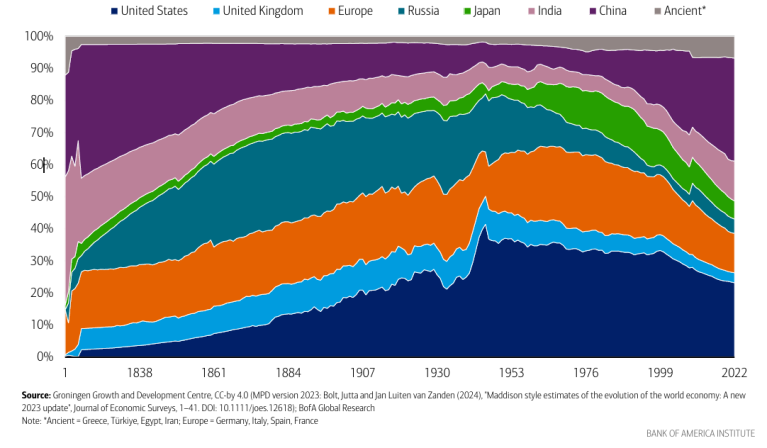
The data, compiled by the Bank of America Institute using historical GDP estimates, shows that for much of recorded history, economic dominance was concentrated in Asia. China and India together accounted for a substantial share of global output for nearly 18 centuries, positioning the region as the center of economic gravity long before the rise of the West.
This perspective challenges the modern assumption that U.S. leadership is a permanent fixture of the global economy.
“The American century” as a historical anomaly
The United States rose to economic prominence relatively recently. Its ascent accelerated in the late 19th century and peaked after World War II, when it accounted for nearly one-third of global GDP.
This period, often referred to as the “American century,” was shaped by unique global conditions. Much of Europe was rebuilding after two world wars, while China faced internal upheaval and India was transitioning out of colonial rule. The result was a temporary concentration of economic power in the United States.
While the concept of American exceptionalism has long influenced political and economic narratives, the historical data suggests that this dominance may have been contingent rather than structural.
Transitions in global leadership, according to the Bank of America Institute, have often followed major geopolitical or financial disruptions. That pattern is now drawing renewed attention.
Dalio’s cycle theory and the return of great power competition
Investor Ray Dalio, founder of Bridgewater Associates, has framed the current moment as part of a recurring cycle in global order. In his analysis, economic and geopolitical systems move through phases that ultimately lead to periods of instability before a new balance emerges.
Dalio has compared the 2020s to pre-World War II conditions, pointing to rising tensions between major powers and shifts in economic influence. His framework outlines cycles that culminate in disorder, followed by the emergence of new dominant players that shape the next global system.
Within this context, the China global economic power shift reflects more than growth metrics. It signals a broader realignment in how economic influence and geopolitical authority are distributed.
China’s resurgence, driven by scale and strategy
China’s economic trajectory over the past two decades has been one of the most significant developments in modern economic history. Its share of global GDP has expanded rapidly, supported by industrial capacity, export strength, and long-term state planning.
Recent policy initiatives indicate a continued focus on manufacturing and technology. The country’s latest five-year plan emphasizes integrating artificial intelligence into industrial production, expanding digital infrastructure, and strengthening domestic innovation capabilities.
This strategy aligns with broader global trends, including the reindustrialization of supply chains and the growing importance of cost efficiency. As industries shift toward automation and advanced manufacturing, China’s scale and infrastructure provide a competitive advantage.
Growth differentials also play a role. While the U.S. economy continues to expand steadily, China’s faster growth rate contributes to a gradual narrowing of the gap in total economic output.
Markets, momentum, and structural pressure
Despite these shifts, the United States remains the world’s largest economy by nominal GDP and continues to lead in financial markets, innovation, and capital formation. American firms dominate key sectors such as technology and finance, and the dollar retains its position as the global reserve currency.
However, market signals in recent periods suggest a more complex outlook. The unwinding of trades tied to U.S. outperformance, alongside stronger relative gains in global indices, has prompted investors to reassess assumptions about long-term dominance.
Structural factors are also evolving. The global economy is seeing renewed emphasis on manufacturing, affordability, and technological transformation. Each of these trends intersects with China’s economic strengths, particularly in production capacity and industrial policy execution.
At the same time, the United States maintains advantages in productivity, higher per capita income, and institutional stability. These factors continue to support its economic resilience, even as relative positioning shifts.
A reversion, not a disruption
The historical chart underpinning this analysis does not suggest a sudden displacement of the United States. Instead, it points to a gradual rebalancing.
For centuries, the world’s largest economies were located in Asia. The rise of the West, and particularly the United States, represented a deviation from that pattern driven by specific historical events.
Today’s China global economic power shift may therefore reflect a normalization rather than a break from precedent. As other regions industrialize, innovate, and integrate into global markets, economic influence becomes more distributed.
For investors and policymakers, the implication is clear. Understanding the present requires looking beyond recent decades and recognizing the deeper cycles that shape global economic leadership.