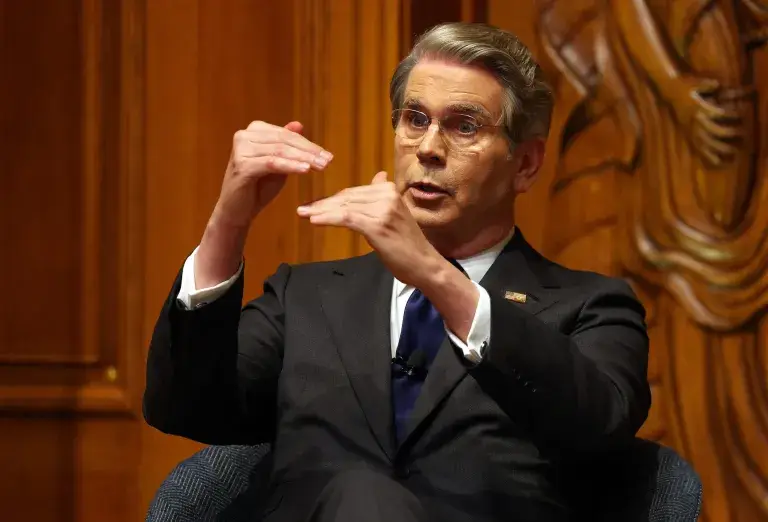
The future of $175 billion in IEEPA tariff revenue is now uncertain after a Supreme Court ruling invalidated the Trump administration’s use of emergency powers to impose sweeping global tariffs. Treasury Secretary Scott Bessent said he believes the American public is unlikely to see any of the funds returned.
Speaking at the Economic Club of Dallas, Bessent acknowledged that the IEEPA tariff revenue could remain tied up in litigation for an extended period. “My sense is that could be dragged out for weeks, months, years,” he said, adding bluntly, “I got a feeling the American people won’t see it.”
The remarks followed a landmark decision by the Supreme Court of the United States, which ruled that the White House could not rely on the International Emergency Economic Powers Act to impose tariffs on trading partners.
A Legal Reversal With Broad Implications
The IEEPA tariffs were first introduced on China in February 2025, before expanding to Canada and Mexico the following month. The administration’s April “Liberation Day” tariff package was also enacted under the same authority.
The Court’s ruling determined that IEEPA did not grant the executive branch the authority to levy import duties in this manner. However, the justices did not clarify how the collected funds should be handled. That question now shifts to international trade courts.
Estimates suggest cumulative IEEPA tariff revenue reached approximately $164.7 billion by January 2026, with collections running at roughly $500 million per day before the ruling. The Penn Wharton Budget Model projects potential refunds could total as much as $175 billion, once adjustments are made for overlapping customs duties and new trade measures.
For now, the funds remain in dispute.
Who Would Benefit From Refunds?
Optimists have suggested that refunding IEEPA tariff revenue could provide a meaningful fiscal boost. Payments would flow to U.S. importers, the entities that remitted the duties to the Treasury.
In theory, businesses could pass some of that capital through to consumers in the form of lower prices. In practice, economists are skeptical.
Paul Donovan, chief economist at UBS, told clients that tariff rebates would likely increase the federal deficit and act as a fiscal stimulus. However, he cautioned that new tariffs are already being introduced under alternative legal authorities, reducing the likelihood that companies would lower prices.
“With new tariffs coming in, it seems unlikely anyone will rush to lower prices to their customers,” Donovan noted.
Other members of the administration have taken a similar stance. U.S. Trade Representative Jamieson Greer said on Fox News Sunday that the matter rests with the courts and that the White House would comply with judicial instructions.
Alternative Authorities Keep Tariffs in Place
Although the IEEPA ruling limits one tool, it does not end the administration’s tariff strategy.
Officials confirmed that a 15 percent tariff rate will be enforced under Section 122 of the 1974 Trade Act for up to 150 days. That temporary authority allows the White House to maintain revenue flows while preparing longer term measures under Section 232, which cites national security, or Section 301, which addresses unfair trade practices.
Bessent emphasized that tariff revenue generation will not drop or slow as a result of the decision. For markets, that assurance reduces immediate fiscal uncertainty but does little to resolve the status of the disputed IEEPA tariff revenue already collected.
A Lower Effective Tariff Rate Ahead?
Despite the administration’s commitment to maintaining tariffs, analysts expect the effective rate to trend lower over time.
The Yale Budget Lab estimates that without IEEPA tariffs, the average effective U.S. tariff rate would stand at 9.1 percent. That remains historically elevated, the highest since 1946 excluding 2025, but significantly below the 16.9 percent rate that would have prevailed had the IEEPA measures remained in force.
Strategists at Deutsche Bank also anticipate moderation. Jim Reid, a senior strategist at the firm, noted that average customs duties have already declined by roughly two percentage points since October, settling near 11 percent due to carve outs and exemptions.
Some analysts attribute the gradual easing to domestic political constraints following weak local election results in early November, which may temper appetite for further escalation.
A Fiscal Question With Political Consequences
The unresolved status of IEEPA tariff revenue leaves policymakers navigating both fiscal and political challenges.
If courts ultimately mandate refunds, the payments would widen the federal deficit in the near term. If litigation stalls or limits repayment, businesses and consumers may view the outcome as a missed economic opportunity.
For now, Bessent’s assessment sets the tone: while the legal process unfolds, the $175 billion collected under emergency authority appears unlikely to reenter the economy anytime soon.