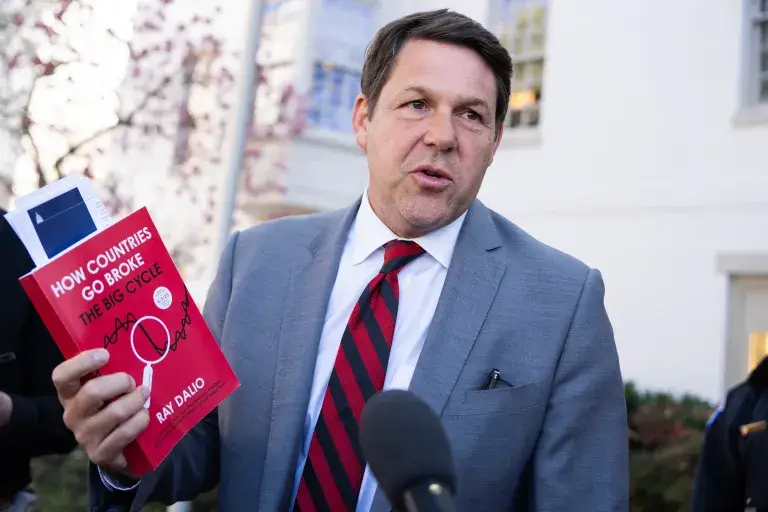
The sharp rise in U.S. debt interest costs has become a new flashpoint in Washington, after House Budget Committee Chairman Jodey Arrington warned that annual interest payments alone now exceed $1 trillion. His remarks came as total federal debt moved beyond $39 trillion, underscoring how quickly the country’s fiscal position has deteriorated.
For Arrington, the symbolism is as striking as the numbers. He noted that it took the United States roughly two centuries to accumulate its first $1 trillion in debt. Today, by contrast, U.S. debt interest costs alone are running above that level on an annual basis, a shift he described as a serious burden on future generations and a sign that lawmakers have failed to respond to the scale of the problem.
From historic milestone to annual burden
Federal debt did not cross the $1 trillion threshold until the early 1980s, during the Reagan era. That benchmark once represented a defining moment in U.S. fiscal history. Now it is no longer the debt total that stands out most sharply, but the cost of carrying it.
According to the figures cited by Arrington, the Treasury paid $1.22 trillion in net interest during fiscal year 2025. For fiscal year 2026, the government has already paid roughly $520 billion. Congressional Budget Office projections suggest annual interest costs could rise to about $2.1 trillion by 2036, a trajectory that would place debt servicing among the most significant claims on the federal budget.
Arrington framed that escalation as more than an accounting issue. He argued it reflects a broader failure of fiscal governance, with borrowing continuing to grow faster than the political system’s willingness to confront spending and revenue choices. His warning adds to a growing chorus from policymakers, economists, and market figures who see debt servicing as an increasingly important economic constraint.
Why the alarm is spreading beyond Capitol Hill
Concern about the national debt is no longer limited to fiscal conservatives in Congress. Business leaders including JPMorgan Chase CEO Jamie Dimon and investor Ray Dalio have publicly warned that unchecked borrowing could eventually trigger deeper instability. Federal Reserve Chair Jerome Powell has also called for a more serious national conversation on the long-term budget outlook.
The underlying concern is straightforward. As debt grows and interest rates remain materially higher than the ultra-low levels seen in the previous decade, the government must devote more resources to interest payments rather than defense, infrastructure, health care, or tax relief. That dynamic does not necessarily create an immediate crisis, but it narrows policy flexibility and raises the stakes of future downturns.
At the same time, there is little consensus on how the problem should be addressed. Some lawmakers and budget groups favor gradual deficit reduction through a mix of spending restraint and tax reform. Others argue that only structural rules can force Washington to act.
A deficit target, or something stronger?
One of the more prominent proposals in circulation comes from the Committee for a Responsible Federal Budget, which has backed a goal of bringing the unified federal deficit down to 3% of gross domestic product. That target has drawn bipartisan support, including from members of the Bipartisan Fiscal Forum such as Reps. Bill Huizenga and Scott Peters.
Arrington, however, is pressing for a tougher route. Rather than treating fiscal discipline as a policy target, he has called for discussion of embedding it in the Constitution through an Article V convention. Under that process, two-thirds of state legislatures can apply for a convention to propose amendments, which would then need ratification from three-quarters of the states.
His argument is rooted in the idea that Congress has proved incapable of restraining itself. In his view, if federal lawmakers will not impose durable limits on borrowing and spending, the states should force the issue through the constitutional process.
Can any fix survive politics?
The challenge, as always, is that every serious debt-reduction plan carries political cost. Past efforts have shown how difficult it is to turn broad fiscal concern into lasting reform. The Simpson-Bowles commission, formed during the Obama administration, outlined a mix of spending cuts, tax changes, and entitlement reforms, but many of its recommendations were never fully enacted.
More recently, President Donald Trump has promoted unconventional ideas to improve federal finances, including a proposed “Gold Card” visa that would charge wealthy immigrants $5 million for permanent residency and a path to citizenship. He has also backed tariffs as a revenue source, even as economists and foreign governments debate their broader consequences.
That range of proposals highlights the central reality of the debt debate. Many in Washington agree that the current path is unsustainable, but there is no shared formula for correction. What is becoming harder to dismiss is the scale of the interest bill itself. When debt servicing passes the trillion-dollar mark, the issue moves from a long-range warning to a more immediate test of national priorities.