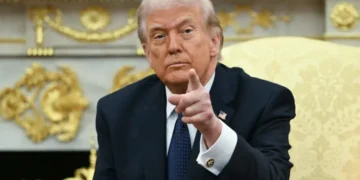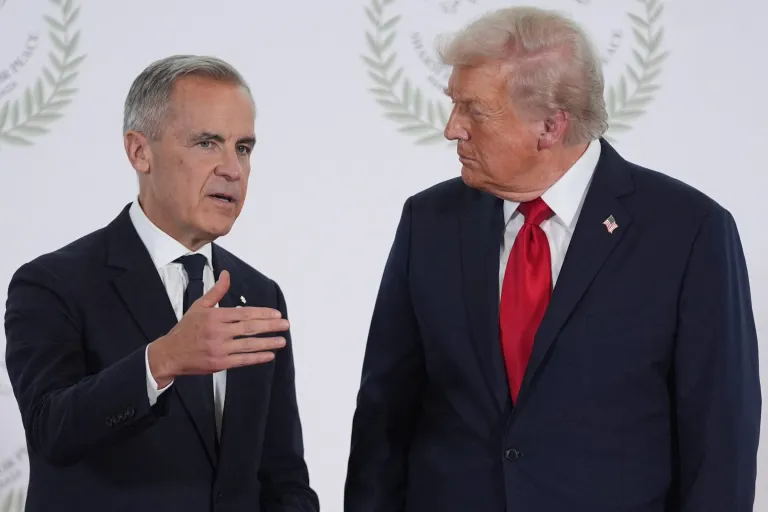
President Donald Trump on Saturday threatened to impose a 100% tariff on Canadian goods if Canada proceeds with a trade deal with China, a sharp reversal from comments he made just days earlier praising the agreement as beneficial.
In a social media post, Trump warned that Canada must not serve as a conduit for Chinese exports destined for the United States. He said that any move by Ottawa to deepen its trade relationship with Beijing would result in immediate and sweeping trade penalties, including a 100% tariff on all Canadian products entering the U.S. market. The threat has heightened uncertainty around North American trade policy and raised questions about the stability of existing agreements.
The 100% tariff on Canada would represent one of the most aggressive trade actions Trump has floated since returning to office, particularly given Canada’s role as one of the United States’ largest trading partners.
From Approval to Threat in Less Than a Week
The warning marks a stark shift from Trump’s remarks on January 15, when he was asked about a newly announced trade agreement between Canada and China. At the time, Trump said it was reasonable for Canada to pursue such a deal, adding that securing trade agreements with major economies was generally positive.
That agreement included reductions in Chinese tariffs on select Canadian agricultural exports and a partial rollback of Canadian tariffs affecting tens of thousands of Chinese electric vehicles. While modest in scope, the deal was framed by both governments as an effort to stabilize bilateral trade ties amid broader global fragmentation.
The sudden reversal underscores the unpredictable nature of Trump’s trade strategy, which has frequently relied on tariffs as a negotiating tool. Markets and policymakers alike have struggled to assess which statements signal durable policy and which are intended as short-term leverage.
Carney’s Global Warning From Davos
Canadian Prime Minister Mark Carney did not directly respond to Trump’s tariff threat, and his office declined to comment immediately. However, days earlier, Carney used a speech at the World Economic Forum in Davos to criticize the growing use of economic pressure in global politics.
Without naming Trump, Carney warned that the world was facing a potential rupture in the international order. He cautioned against using tariffs as leverage, financial systems as tools of coercion, and supply chains as vulnerabilities to be exploited. The remarks were widely interpreted as a response to recent U.S. threats targeting allies and rivals alike.
Carney’s comments came after Trump had floated tariffs on NATO members and suggested dramatic changes to longstanding security and trade arrangements.
Trade Agreements and Legal Limits
Trump later backed away from some of his earlier tariff threats toward NATO allies, including Canada, and agreed to a loose framework covering Greenland and a proposed missile defense initiative. However, details of those arrangements remain unclear, adding to concerns about the administration’s long-term trade posture.
It also remains uncertain whether a 100% tariff on Canada would apply to goods covered under the U.S.-Mexico-Canada Agreement, which has so far shielded most North American trade from Trump’s global tariff proposals. The administration has not clarified whether such exemptions would be removed.
Complicating matters further, the Supreme Court of the United States has yet to rule on the scope of Trump’s authority to impose tariffs under the International Emergency Economic Powers Act, a central pillar of his trade strategy. A decision limiting that authority could constrain future tariff actions, while a favorable ruling would expand presidential power over trade policy.
Markets Brace for More Volatility
Trump’s latest threat follows similar warnings aimed at countries trading with Iran, signaling a renewed willingness to weaponize tariffs across multiple fronts. Analysts say the approach risks destabilizing supply chains and reigniting trade conflicts that had cooled in recent years.
For Canada, the stakes are high. The United States remains its largest export market, and even the prospect of a 100% tariff on Canada could chill investment and disrupt cross-border commerce. For global markets, the episode reinforces a familiar lesson, under the current administration, trade policy can change quickly, and often without warning.